
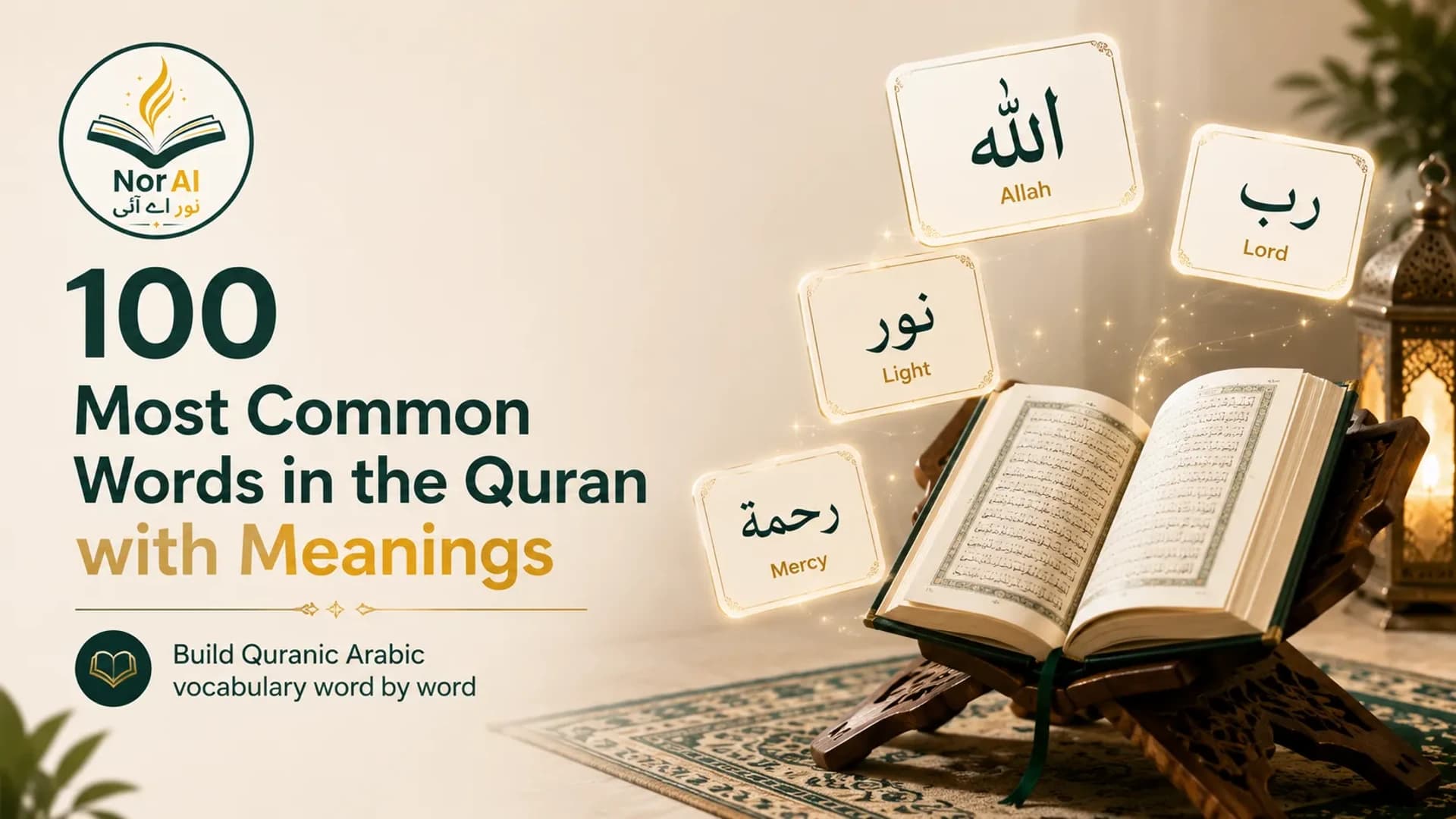
100 Most Common Words in the Quran with Meanings
Learning the 100 most common words in the Quran with meanings is one of the best ways to begin understanding Quranic Arabic. Many learners can read or recite the Quran, but they often find it difficult to understand the meanings of the Arabic words they read.
When beginners start with repeated Quranic words, the Quran becomes easier to follow, and familiar words begin to appear again and again during recitation. For anyone who wants to learn Quran with better understanding, common Quranic words are a strong place to begin.
NorAI helps make Quranic Arabic learning simple by focusing on word-by-word understanding. Instead of overwhelming learners with long grammar lessons, NorAI supports learners through visual learning, recitation audio, articulation practice, writing practice, structured lessons, and revision.
This makes it easier for beginners, families, adults, and young learners to build Quran vocabulary step by step.
Why Learn the Most Common Quranic Words First?
The Quran contains many repeated words. When learners understand common Quranic Arabic words, they can begin to recognize meanings more naturally.
This does not mean a learner will understand every verse immediately, but it gives them a strong starting point.
Learning common words helps students:
- Understand repeated Quranic vocabulary
- Build confidence during recitation
- Recognize familiar words in different Surahs
- Improve Quranic Arabic understanding
- Connect more deeply with the message of the Quran
- Develop a steady learning routine
This is why Quran word-by-word learning is especially useful for beginners. It breaks the learning process into small and manageable steps.
100 Common Quranic Arabic Words with Meanings
Below is a beginner-friendly list of common Quranic Arabic words with simple English meanings.
Some Arabic words may have different meanings depending on the verse and context, but these meanings give learners a useful starting point.
| No. | Arabic Word | Transliteration | Simple Meaning |
|---|---|---|---|
| 1 | قرآن | Quran | Recitation, Quran |
| 2 | آية | Ayah | Sign, verse |
| 3 | جنة | Jannah | Paradise |
| 4 | رزق | Rizq | Provision |
| 5 | إيمان | Iman | Faith |
| 6 | تقوى | Taqwa | God-consciousness |
| 7 | صبر | Sabr | Patience |
| 8 | شكر | Shukr | Gratitude |
| 9 | صلاة | Salah | Prayer |
| 10 | زكاة | Zakah | Charity |
| 11 | ذكر | Dhikr | Remembrance |
| 12 | دعاء | Dua | Supplication |
| 13 | توبة | Tawbah | Repentance |
| 14 | صراط | Sirat | Path |
| 15 | نبي | Nabi | Prophet |
| 16 | ميزان | Meezan | Balance |
| 17 | عبادة | Ibadah | Worship |
| 18 | ملائكة | Malaikah | Angels |
| 19 | الله | Allah | Allah |
| 20 | رب | Rabb | Lord |
| 21 | رحمن | Rahman | Most Merciful |
| 22 | رحيم | Raheem | Merciful |
| 23 | ملك | Malik | King |
| 24 | يوم | Yawm | Day |
| 25 | دين | Deen | Religion, judgment |
| 26 | هدى | Huda | Guidance |
| 27 | كتاب | Kitab | Book |
| 28 | ناس | Naas | People |
| 29 | مؤمنون | Muminoon | Believers |
| 30 | كافرون | Kafiroon | Disbelievers |
| 31 | مسلمون | Muslimoon | Muslims |
| 32 | قلب | Qalb | Heart |
| 33 | صدق | Sidq | Truth |
| 34 | حق | Haqq | Truth, right |
| 35 | باطل | Batil | Falsehood |
| 36 | خير | Khayr | Good |
| 37 | شر | Sharr | Evil |
| 38 | نور | Noor | Light |
| 39 | ظلمات | Zulumaat | Darknesses |
| 40 | نار | Naar | Fire |
| 41 | أرض | Ard | Earth |
| 42 | سماء | Samaa | Sky, heaven |
| 43 | ماء | Maa | Water |
| 44 | حياة | Hayah | Life |
| 45 | موت | Mawt | Death |
| 46 | نفس | Nafs | Soul, self |
| 47 | روح | Rooh | Spirit |
| 48 | علم | Ilm | Knowledge |
| 49 | عمل | Amal | Deed, action |
| 50 | صالح | Salih | Righteous |
| 51 | سيئة | Sayyi'ah | Bad deed |
| 52 | رحمة | Rahmah | Mercy |
| 53 | مغفرة | Maghfirah | Forgiveness |
| 54 | عذاب | Azab | Punishment |
| 55 | سبيل | Sabeel | Way, path |
| 56 | مستقيم | Mustaqeem | Straight |
| 57 | رسول | Rasool | Messenger |
| 58 | قوم | Qawm | People, nation |
| 59 | أمة | Ummah | Community |
| 60 | بيت | Bayt | House |
| 61 | مسجد | Masjid | Place of prayer |
| 62 | دنيا | Dunya | Worldly life |
| 63 | آخرة | Akhirah | Hereafter |
| 64 | ساعة | Sa'ah | Hour |
| 65 | حساب | Hisab | Account |
| 66 | عهد | Ahd | Covenant |
| 67 | وعد | Wa'd | Promise |
| 68 | أمر | Amr | Command, matter |
| 69 | خلق | Khalaq | Created |
| 70 | جعل | Ja'ala | Made, placed |
| 71 | قال | Qala | He said |
| 72 | يعلم | Ya'lam | He knows |
| 73 | يسمع | Yasma' | He hears |
| 74 | يرى | Yara | He sees |
| 75 | يغفر | Yaghfir | He forgives |
| 76 | يهدي | Yahdi | He guides |
| 77 | يحب | Yuhibb | He loves |
| 78 | يشاء | Yasha | He wills |
| 79 | كان | Kana | Was, is |
| 80 | تكون | Takoon | Be, become |
| 81 | جاء | Jaa | Came |
| 82 | ذهب | Dhahab | Went |
| 83 | دخل | Dakhala | Entered |
| 84 | خرج | Kharaja | Went out |
| 85 | اتبع | Ittaba'a | Followed |
| 86 | كذب | Kadhaba | Denied, lied |
| 87 | آمن | Aamana | Believed |
| 88 | كفر | Kafara | Disbelieved |
| 89 | عبد | Abd | Servant, worshipper |
| 90 | خوف | Khawf | Fear |
| 91 | حزن | Huzn | Sadness |
| 92 | فرح | Farah | Joy |
| 93 | سلام | Salam | Peace |
| 94 | نعمة | Ni'mah | Blessing |
| 95 | فضل | Fadl | Favor, bounty |
| 96 | عدو | Aduww | Enemy |
| 97 | ولي | Wali | Protector, ally |
| 98 | سبيل الله | Sabeel Allah | Way of Allah |
| 99 | إنسان | Insan | Human being |
| 100 | شيطان | Shaytan | Satan |
How These Words Help Beginners Understand the Quran
When learners study these common Quranic words, they begin to notice familiar meanings during recitation.
Words like Allah, Rabb, Yawm, Kitab, Rahmah, Huda, Iman, and Sabr appear across the Quran and help learners feel more connected to what they are reading.
This approach is especially helpful for non-Arabic speakers. Instead of trying to understand full Arabic grammar immediately, beginners can first build a strong vocabulary base.
Once repeated words become familiar, learners can slowly move toward understanding phrases, verses, and deeper meanings.
Learn Quranic Words Step by Step with NorAI
NorAI is designed to help learners understand Quranic Arabic word by word.
The app supports learners through:
- Visual learning
- Recitation audio
- Articulation practice
- Writing practice
- Structured revision
These features make common Quranic words easier to recognize, remember, and review.
When learners study a word, they can see the word, hear it clearly, practice its sound, understand its meaning, and revise it later.
This gives learners more than one way to remember Quranic vocabulary.
Why Word-by-Word Quran Learning Works
Word-by-word learning works because it makes the Quran feel less difficult for beginners.
Instead of facing long verses without understanding, learners begin with smaller parts. Each word becomes a building block.
This method helps learners:
- Recognize repeated Quranic Arabic words
- Understand meanings gradually
- Improve listening and pronunciation awareness
- Build confidence through short practice
- Develop a stronger connection with recitation
- Review words without feeling overwhelmed
Over time, these small steps create real progress.
How to Memorize Common Quranic Words
Memorizing Quranic words becomes easier when learners follow a simple routine.
Start with five to ten words at a time. Read the Arabic word, listen to its pronunciation, repeat it aloud, write it down, and review it again later.
A simple study routine can include:
- Learning five Quranic words daily
- Listening to each word carefully
- Repeating the word aloud
- Writing the word once or twice
- Reviewing previously learned words
- Looking for familiar words during recitation
NorAI supports this kind of steady practice by helping learners revise words regularly and continue learning at a comfortable pace.
Common Mistakes Beginners Should Avoid
Many beginners try to memorize too many Quranic words at once. This can make learning feel difficult and tiring.
It is better to learn slowly and revise often.
Another common mistake is learning only the English meaning without looking at the Arabic word.
To build real Quranic Arabic understanding, learners should connect the Arabic word, sound, and meaning together.
Beginners should also avoid depending only on translation. Translation is helpful, but word-by-word Quranic Arabic learning helps learners recognize meanings directly in the Arabic text.
How NorAI Supports Quran Vocabulary Learning
NorAI helps learners build Quran vocabulary through a structured and beginner-friendly system.
The app focuses on Quranic Arabic words, not general Arabic conversation. This makes it useful for learners who want to understand Quranic words and meanings.
NorAI supports learners with:
- Word-by-word Quranic Arabic learning
- Visual practice for word recognition
- Recitation audio for listening support
- Articulation practice for pronunciation awareness
- Writing practice for stronger memory
- Progress tracking for motivation
- Offline learning for flexible practice
- Family-safe learning for children and parents
This makes NorAI a practical option for beginners who want to learn Quranic Arabic in a simple and guided way.
Final Thoughts
Learning the 100 most common words in the Quran with meanings is a strong first step for anyone who wants to understand Quranic Arabic.
These words help learners recognize repeated vocabulary, build confidence, and connect more deeply with the Quran during recitation.
NorAI makes this journey easier by offering structured word-by-word Quranic Arabic learning through visual practice, recitation audio, writing practice, articulation practice, and revision.
With regular practice, beginners can slowly build Quran vocabulary and understand more of what they read.
For anyone starting their Quranic Arabic journey, common Quranic words are a helpful place to begin.
FAQs
What are the most common words in the Quran?
The most common words in the Quran include words such as Allah, Rabb, Yawm, Kitab, Huda, Rahmah, Iman, Sabr, Jannah, Naar, and many other repeated Quranic Arabic words.
Why should beginners learn Quranic words first?
Beginners should learn Quranic words first because repeated vocabulary helps them understand verses more easily and build confidence during recitation.
Does NorAI help with Quran word-by-word learning?
Yes, NorAI helps learners study Quranic Arabic word by word through visual learning, recitation audio, articulation practice, writing practice, and revision.
Can I learn Quranic Arabic without knowing full Arabic grammar?
Yes, beginners can start by learning common Quranic words and meanings. Full grammar can come later as understanding improves.
What is the meaning of Rahman?
Rahman means the Most Merciful. In the Quran, Ar-Rahman is one of the beautiful names of Allah and reflects His vast mercy, kindness, and compassion for all creation.
What is the meaning of Noor?
Noor means light. In Quranic Arabic, Noor can refer to guidance, clarity, brightness, and spiritual light that helps people understand the truth.