
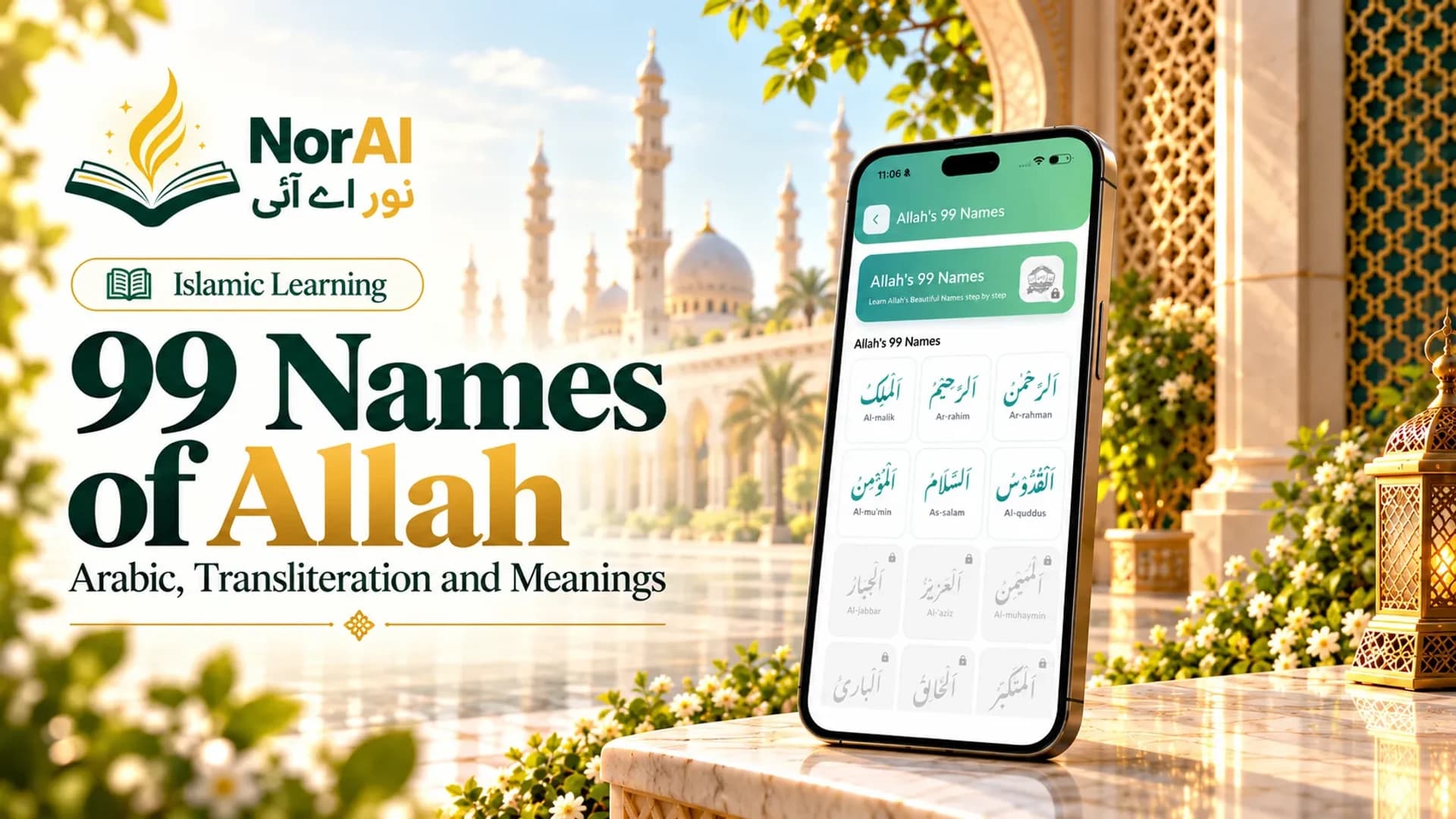
99 Names of Allah ArabicTransliteration and Meanings
Summary: The 99 Names of Allah, commonly known as Asma ul Husna, describe Allah’s attributes. This guide helps beginners, adult learners and families study the Arabic names, understand their meanings, practise pronunciation and use the names in dua through a manageable learning routine.
The 99 Names of Allah, commonly studied as Asma ul Husna, help Muslims learn about Allah’s mercy, knowledge, power and perfection. Learning them involves recognising the Arabic names, understanding their meanings and calling upon Allah through them. Quran 7:180 instructs believers to call upon Allah by His beautiful names.
This guide is for beginners, adults returning to Islamic learning and families learning together. You will find a complete commonly used list, simple meanings, Quran references and a practical way to study without rushing.
NorAI is a Quran and Islamic learning app for children, adults and families. Its 99 Names of Allah section brings together Arabic names, transliteration, simple meanings, audio pronunciation and guided practice.
Key takeaway: Learn a few names carefully, listen to their pronunciation and understand what they mean before adding more.
What does Asma ul Husna mean?
Short answer: Asma ul Husna means “the Most Beautiful Names”. These names describe Allah’s perfection and help us understand whom we worship and turn to in dua.
For example, Ar-Rahman points to Allah’s mercy, Al-‘Alim to His complete knowledge and Al-Hakim to His wisdom. Studying these meanings gives familiar words more depth when we encounter them in prayer or Quran recitation.
In Surah Al-A‘raf, verse 180 connects Allah’s beautiful names with calling upon Him. This gives learning the names a practical purpose: knowing their meanings can inform the way we make dua.
What does the hadith say about the 99 Names of Allah?
Short answer: An authentic hadith promises Paradise to those who encompass Allah’s ninety-nine names. The narration appears in Sahih al-Bukhari 2736. Its wording is often translated using terms such as knowing, preserving or enumerating the names.
Learning should therefore include attention to meaning. The English rendering of Sahih al-Bukhari 6410 explicitly connects the names with belief in their meanings and acting accordingly. A useful approach is to memorise them, understand them and let that understanding inform worship.
There is also a distinction between the authentic hadith about ninety-nine names and a particular numbered list. The Bukhari narration does not enumerate every name. Published compilations can differ, so a familiar chart should not be described as the single numbered list supplied by that narration.
The 99 Names of Allah with Arabic and simple meanings
The table below follows the commonly used sequence in NorAI learning material. The English meanings are brief learning aids, not exhaustive explanations of each name. For another published reference, see My Islam’s guide to the 99 Names of Allah.
How to read the transliteration: ā, ī and ū indicate long vowels. The symbol ‘ represents the Arabic letter ‘ayn, while ’ represents hamzah. English letters cannot fully represent Arabic pronunciation, so listen to reliable audio alongside the text.
| No. | Arabic | Transliteration | Simple English meaning |
|---|---|---|---|
| 1 | اَلرَّحۡمٰنُ | Ar-Raḥmān | The Most Compassionate |
| 2 | اَلرَّحِيۡمُ | Ar-Raḥīm | The Most Merciful |
| 3 | اَلۡمَلِكُ | Al-Malik | The King |
| 4 | اَلۡقُدُّوۡسُ | Al-Quddūs | The Most Holy, free from imperfection |
| 5 | اَلسَّلَامُ | As-Salām | The One free from all defects; the Source of Peace |
| 6 | اَلۡمُؤۡمِنُ | Al-Mu’min | The Giver of security |
| 7 | اَلۡمُهَيۡمِنُ | Al-Muhaymin | The Guardian and Overseer |
| 8 | اَلۡعَزِيۡزُ | Al-‘Azīz | The Almighty |
| 9 | اَلۡجَبَّارُ | Al-Jabbār | The Compeller and Restorer |
| 10 | اَلۡمُتَكَبِّرُ | Al-Mutakabbir | The One supreme in greatness |
| 11 | اَلۡخَالِقُ | Al-Khāliq | The Creator |
| 12 | اَلۡبَارِئُ | Al-Bāri’ | The One who brings creation into being |
| 13 | اَلۡمُصَوِّرُ | Al-Muṣawwir | The One who gives creation its forms |
| 14 | اَلۡغَفَّارُ | Al-Ghaffār | The One who forgives repeatedly |
| 15 | اَلۡقَهَّارُ | Al-Qahhār | The One who prevails over all |
| 16 | اَلۡوَهَّابُ | Al-Wahhāb | The Bestower of gifts |
| 17 | اَلرَّزَّاقُ | Ar-Razzāq | The Provider |
| 18 | اَلۡفَتَّاحُ | Al-Fattāḥ | The Opener and Judge |
| 19 | اَلۡعَلِيۡمُ | Al-‘Alīm | The All-Knowing |
| 20 | اَلۡقَابِضُ | Al-Qābiḍ | The One who withholds |
| 21 | اَلۡبَاسِطُ | Al-Bāsiṭ | The One who expands and grants abundance |
| 22 | اَلۡخَافِضُ | Al-Khāfiḍ | The One who lowers |
| 23 | اَلرَّافِعُ | Ar-Rāfi‘ | The One who raises |
| 24 | اَلۡمُعِزُّ | Al-Mu‘izz | The Giver of honour |
| 25 | اَلۡمُذِلُّ | Al-Mudhill | The One who brings low |
| 26 | اَلسَّمِيۡعُ | As-Samī‘ | The All-Hearing |
| 27 | اَلۡبَصِيۡرُ | Al-Baṣīr | The All-Seeing |
| 28 | اَلۡحَكَمُ | Al-Ḥakam | The Judge |
| 29 | اَلۡعَدۡلُ | Al-‘Adl | The Perfectly Just |
| 30 | اَللَّطِيۡفُ | Al-Laṭīf | The Most Subtle and Gentle |
| 31 | اَلۡخَبِيۡرُ | Al-Khabīr | The All-Aware |
| 32 | اَلۡحَلِيۡمُ | Al-Ḥalīm | The Forbearing |
| 33 | اَلۡعَظِيۡمُ | Al-‘Aẓīm | The Magnificent |
| 34 | اَلۡغَفُوۡرُ | Al-Ghafūr | The All-Forgiving |
| 35 | اَلشَّكُوۡرُ | Ash-Shakūr | The One who rewards and appreciates good |
| 36 | اَلۡعَلِیُّ | Al-‘Aliyy | The Most High |
| 37 | اَلۡكَبِيۡرُ | Al-Kabīr | The Most Great |
| 38 | اَلۡحَفِيۡظُ | Al-Ḥafīẓ | The Preserver |
| 39 | اَلۡمُقِيۡتُ | Al-Muqīt | The Sustainer |
| 40 | اَلۡحَسِيۡبُ | Al-Ḥasīb | The Reckoner; the One who suffices |
| 41 | اَلۡجَلِيۡلُ | Al-Jalīl | The Majestic |
| 42 | اَلۡكَرِيۡمُ | Al-Karīm | The Generous and Noble |
| 43 | اَلرَّقِيۡبُ | Ar-Raqīb | The Watchful |
| 44 | اَلۡمُجِيبُ | Al-Mujīb | The One who answers |
| 45 | اَلۡوَاسِعُ | Al-Wāsi‘ | The All-Encompassing |
| 46 | اَلۡحَكِيۡمُ | Al-Ḥakīm | The All-Wise |
| 47 | اَلۡوَدُودُ | Al-Wadūd | The Most Loving |
| 48 | اَلمَجِيۡدُ | Al-Majīd | The All-Glorious |
| 49 | اَلۡبَاعِثُ | Al-Bā‘ith | The One who raises the dead |
| 50 | اَلشَّهِيۡدُ | Ash-Shahīd | The Witness over all |
| 51 | اَلۡحَقُّ | Al-Ḥaqq | The Truth |
| 52 | اَلۡوَكِيۡلُ | Al-Wakīl | The Trustee and Disposer of affairs |
| 53 | اَلۡقَوِیُّ | Al-Qawiyy | The All-Strong |
| 54 | اَلۡمَتِيۡنُ | Al-Matīn | The One firm in strength |
| 55 | اَلۡوَلِیُّ | Al-Waliyy | The Protecting Guardian |
| 56 | اَلۡحَمِيۡدُ | Al-Ḥamīd | The One worthy of all praise |
| 57 | اَلۡمُحۡصِیۡ | Al-Muḥṣī | The One who accounts for everything |
| 58 | اَلۡمُبۡدِئُ | Al-Mubdi’ | The Originator |
| 59 | اَلۡمُعِيۡدُ | Al-Mu‘īd | The One who brings back |
| 60 | اَلۡمُحۡيِیۡ | Al-Muḥyī | The Giver of life |
| 61 | اَلۡمُمِيۡتُ | Al-Mumīt | The One who causes death |
| 62 | اَلۡحَیُّ | Al-Ḥayy | The Ever-Living |
| 63 | اَلۡقَيُّوۡمُ | Al-Qayyūm | The Self-Sustaining Sustainer of all |
| 64 | اَلۡوَاجِدُ | Al-Wājid | The One who lacks nothing |
| 65 | اَلۡمَاجِدُ | Al-Mājid | The Noble and Glorious |
| 66 | اَلۡوَاحِدُ | Al-Wāḥid | The One |
| 67 | اَلۡاَحَدُ | Al-Aḥad | The Unique One |
| 68 | اَلصَّمَدُ | Aṣ-Ṣamad | The One needed by all, who needs none |
| 69 | اَلۡقَادِرُ | Al-Qādir | The All-Powerful |
| 70 | اَلۡمُقۡتَدِرُ | Al-Muqtadir | The One with complete power |
| 71 | اَلۡمُقَدِّمُ | Al-Muqaddim | The One who brings forward |
| 72 | اَلۡمُؤَخِّرُ | Al-Mu’akhkhir | The One who delays |
| 73 | اَلۡاَوَّلُ | Al-Awwal | The First |
| 74 | اَلۡاٰخِرُ | Al-Ākhir | The Last |
| 75 | اَلظَّاهِرُ | Aẓ-Ẓāhir | The Manifest |
| 76 | اَلۡبَاطِنُ | Al-Bāṭin | The Hidden |
| 77 | اَلۡوَالِیۡ | Al-Wālī | The Governor of all affairs |
| 78 | اَلۡمُتَعَالُ | Al-Muta‘ālī | The Supremely Exalted |
| 79 | اَلۡبَرُّ | Al-Barr | The Source of goodness |
| 80 | اَلتَّوَّابُ | At-Tawwāb | The One who repeatedly accepts repentance |
| 81 | اَلۡمُنۡتَقِمُ | Al-Muntaqim | The One who requites wrongdoing |
| 82 | اَلۡعَفُوُّ | Al-‘Afuww | The Pardoner |
| 83 | اَلرَّؤُفُ | Ar-Ra’ūf | The Most Kind |
| 84 | مَالِكُ الۡمُلۡكِ | Mālik-ul-Mulk | The Owner of all dominion |
| 85 | ذُوالۡجَلَالِ وَالۡاِکۡرَامِ | Dhul-Jalāli wal-Ikrām | The Lord of Majesty and Honour |
| 86 | اَلۡمُقۡسِطُ | Al-Muqsiṭ | The One who acts with perfect justice |
| 87 | اَلۡجَامِعُ | Al-Jāmi‘ | The Gatherer |
| 88 | اَلۡغَنِیُّ | Al-Ghaniyy | The Self-Sufficient |
| 89 | اَلۡمُغۡنِیۡ | Al-Mughnī | The One who enriches |
| 90 | اَلۡمَانِعُ | Al-Māni‘ | The One who prevents and withholds |
| 91 | اَلضَّارُّ | Aḍ-Ḍārr | The One who ordains adversity |
| 92 | اَلنَّافِعُ | An-Nāfi‘ | The One who grants benefit |
| 93 | اَلنُّوۡرُ | An-Nūr | The Light |
| 94 | اَلۡهَادِیۡ | Al-Hādī | The Guide |
| 95 | اَلۡبَدِيۡعُ | Al-Badī‘ | The Incomparable Originator |
| 96 | اَلۡبَاقِیۡ | Al-Bāqī | The Everlasting |
| 97 | اَلۡوَارِثُ | Al-Wārith | The Inheritor |
| 98 | اَلرَّشِيۡدُ | Ar-Rashīd | The Guide to what is right |
| 99 | اَلصَّبُوۡرُ | Aṣ-Ṣabūr | The One who does not hasten punishment |
Some names have overlapping English meanings but distinct Arabic wording. For example, Al-Majīd at number 48 and Al-Mājid at number 65 are written differently in Arabic. Likewise, Al-Waliyy and Al-Wālī should not be treated as identical spellings.
Where can you find Allah’s names in the Quran?
Short answer: Allah’s names appear in many Quran passages, including Surah Al-Hashr (59:22-24) and Surah Al-Ikhlas (112:1-4).
You can begin with short passages where several names appear together. This helps you connect a name with the surrounding message instead of learning only an isolated English equivalent.
Surah Al-Hashr: mercy, authority and creation
The closing verses of Surah Al-Hashr, 59:22–24, contain several names, including Ar-Rahman, Ar-Rahim, Al-Malik, Al-Quddus, Al-Khaliq and Al-Musawwir.
Read these verses slowly and notice how the names appear alongside Allah’s knowledge, authority and creation. This is a useful passage to revisit after learning the opening names in the table.
Surah Al-Ikhlas: oneness and complete independence
Surah Al-Ikhlas, 112:1–4, introduces Allah as One and as As-Samad. It also states that nothing is comparable to Him.
For a beginner, these verses provide a short passage to study alongside the meanings of Al-Ahad and As-Samad.
Try this learning exercise:
- Read the name in Arabic.
- Locate it in the passage.
- Read the verse’s meaning.
- Explain the name in one simple sentence.
- Return to the passage during your next review.
How can you use Allah’s names in dua?
Short answer: Call upon Allah using His names while asking for what you need. Quran 7:180 provides the basis for invoking Him through His beautiful names. Understanding a name helps you make a thoughtful request.
The examples below are personal supplications written for illustration, not quotations from the Quran or hadith.
| Name | Meaning to remember | Example personal dua |
|---|---|---|
| Ar-Rahman | Allah’s mercy | “O Allah, the Most Compassionate, have mercy on me and my family.” |
| Al-Ghafur | Allah’s forgiveness | “O Allah, the All-Forgiving, forgive my mistakes and help me turn back to You.” |
| Ar-Razzaq | Allah provides | “O Allah, the Provider, grant me lawful provision and gratitude for what I have.” |
| Al-Hakim | Allah’s wisdom | “O Allah, the All-Wise, guide my decisions towards what pleases You.” |
You can also explore NorAI’s Daily Duas to learn supplications with their meanings and references.
Avoid treating a name as a formula that guarantees a particular worldly result. Claims that a set number of repetitions will certainly bring money, marriage or success need specific, reliable evidence.
How can beginners learn the 99 Names of Allah?
Short answer: Start with a small group, understand each meaning and review before adding more. Choose an amount that you can manage comfortably. There is no need to turn the list into a race.
1. Choose a few names
You could begin with names you already hear, such as Ar-Rahman and Ar-Rahim. Familiar sounds give you a starting point.
If two or three names feel manageable, stay with them until you can recognise and explain them. The number is a study choice, not a prescribed religious count.
2. Listen before relying on transliteration
Listen to each name while looking at the Arabic. Then repeat it slowly.
Sounds represented by ḥ, ‘ or ḍ may be unfamiliar to English speakers. Ask someone qualified to help with pronunciation when you are unsure.
3. Check the meaning without looking
Cover the English column and ask yourself: “What does this name mean?”
Then reverse the exercise. Read a meaning and try to recall its Arabic name. If several names have related meanings, study their fuller explanations rather than assuming they are interchangeable.
4. Connect the name with a Quran passage
When you learn Al-Malik, revisit Surah Al-Hashr 59:23. When you learn As-Samad, revisit Surah Al-Ikhlas 112:2.
A verse gives you somewhere to return when a name feels unfamiliar.
5. Review before moving on
Begin the next session with the names you studied previously. Add new ones when the earlier group feels familiar.
If you forget a name, look it up and practise it again. Forgetting shows you what needs review.
A flexible five-minute practice routine
| Time | What to do |
|---|---|
| First minute | Recall names from the previous session. |
| Next two minutes | Listen to and practise a small group of names. |
| Fourth minute | Read their meanings and explain one without looking. |
| Final minute | Make a personal dua or revisit a related Quran passage. |
This is a suggested study routine. Adjust it to your ability and available time; it is not a religiously prescribed schedule.
Which learning method should you choose?
Short answer: Use audio and transliteration to practise pronunciation, recall exercises to learn meanings, and regular review to remember the names. Families can study one name together at a time.
Choose the method that addresses your current difficulty. Someone who recognises the names but forgets their meanings needs a different exercise from someone learning Arabic sounds for the first time.
| Your starting point | What to focus on | A useful exercise |
|---|---|---|
| You cannot yet read Arabic confidently | Recognising sounds and letters | Listen while following the Arabic and transliteration. |
| You can recite the names but forget their meanings | Understanding | Match a name to its meaning, then explain it aloud. |
| Similar names become mixed up | Distinguishing wording and meaning | Compare two names carefully with their Arabic spelling. |
| You are learning as a family | A manageable shared routine | Study one name together and let each person explain it. |
| You already know much of the list | Context and review | Find familiar names in Quran passages and revisit their explanations. |
For children, keep questions concrete. After studying Al-Khaliq, ask, “What does Al-Khaliq mean?” Let the child answer before helping.
Adults can use the same exercise. A simple explanation is often a better check of understanding than reciting a long list quickly.
Learn the names step by step with NorAI
NorAI 99 Names of Allah learning section brings together Arabic names, transliteration, simple meanings, audio pronunciation and guided practice.
Use it to focus on a small group at a time. Listen, read the meaning and revisit names you find difficult. Families can study together while allowing each learner to progress at a comfortable pace.
Begin with a name you recognise. Check whether you understand its meaning as well as its sound.
Frequently asked questions
Does Allah have only 99 names?
No. The hadith about ninety-nine names does not limit all of Allah’s names to that number. Ibn Kathir’s explanation of Quran 7:180 explicitly states that His names are not restricted to ninety-nine.
Are all 99 names listed together in the Quran?
No. The Quran contains many of Allah’s names across different verses, but it does not present this numbered table as one passage. Some passages, such as Surah Al-Hashr 59:22–24, bring several names together.
Why do some lists or spellings differ?
English transliteration has several conventions. For example, “Ar-Raheem” and “Ar-Raḥīm” represent the same Arabic name.
Differences in the actual names included are a separate matter. The authentic Bukhari narration gives the number and reward without supplying a numbered list, so do not assume every published compilation is identical.
Is memorising the names enough?
Memorisation is a valuable part of learning. Study the meanings too, and consider how they inform your belief, dua and worship. The rendering of Sahih al-Bukhari 6410 connects knowing the names with believing in their meanings and acting accordingly.
How long does it take to learn all 99 names?
There is no fixed timetable. Your familiarity with Arabic, the amount you already know and how often you review will affect your progress.
Choose a pace that allows you to remember meanings as well as sounds. Revisit difficult names before increasing the number you study.
Can I start with English meanings?
Yes, you can begin studying the English meanings while gradually learning the Arabic names. Use transliteration and reliable audio together, remembering that a short English label cannot convey every aspect of a name’s meaning.