
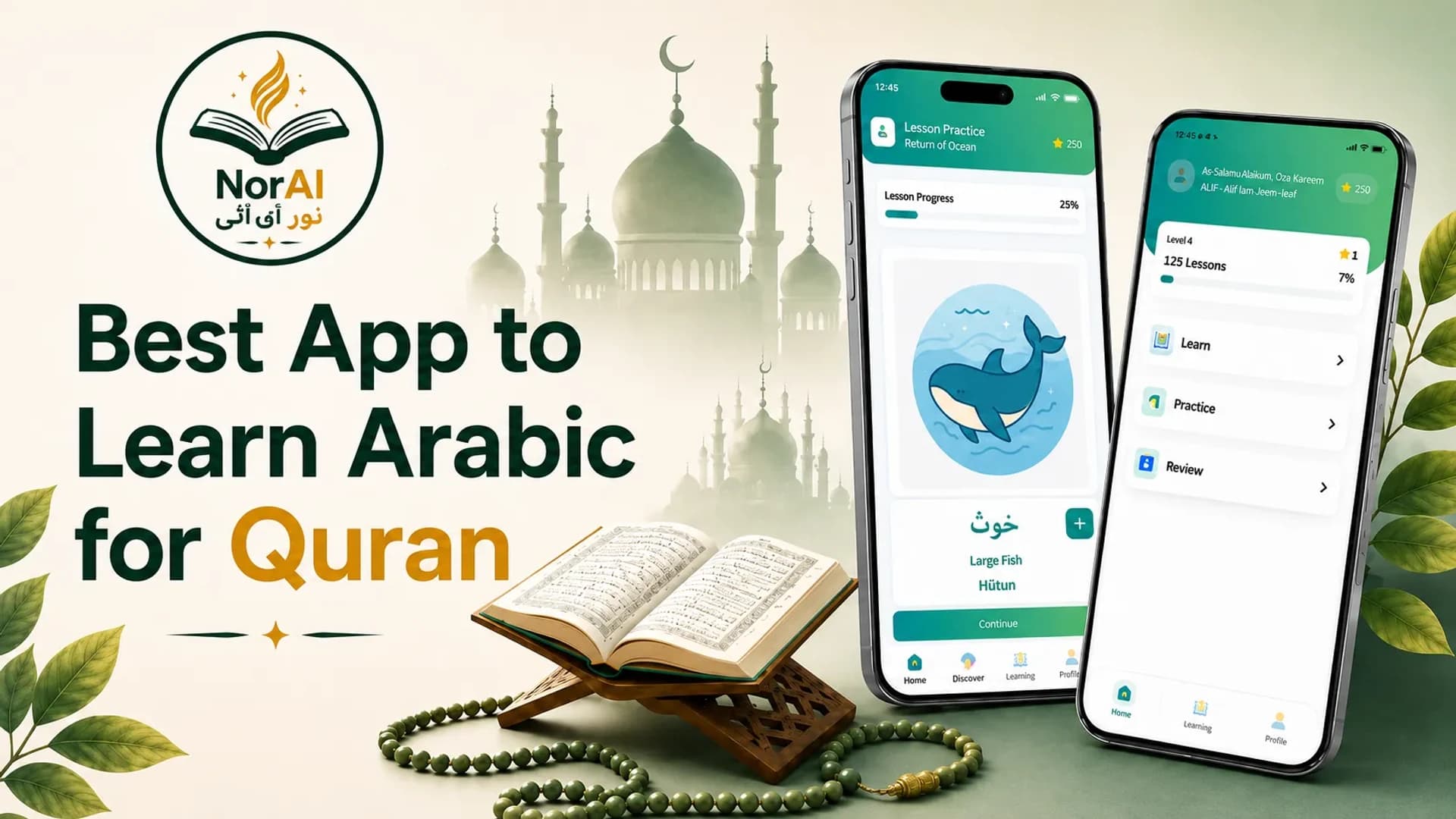
Best App to Learn Arabic for Quran with NorAI
Many Muslims can read or recite the Quran but still wish they understood more of the words they encounter. Recitation is an important part of worship, yet recognising the meaning of Quranic vocabulary can make reading and listening more thoughtful and personal.
This is why many learners search for the best app to learn Arabic for Quran. They want a clear way to study Quranic words without beginning with long grammar lessons or unrelated conversational phrases.
NorAI is designed around this goal. It helps adults, children, and families study Quranic Arabic word by word through visuals, recitation audio, articulation guidance, writing support, structured practice, and progress tracking.
Instead of presenting too much information at once, NorAI introduces learning gradually. Learners can focus on individual words, connect them with their meanings, practise them in different ways, and review them over time.
Why Learning Quranic Arabic Matters
Translations help readers understand the general message of a verse, but learning Quranic Arabic allows them to notice the original words directly.
A word that once sounded unfamiliar may become recognisable during recitation. As vocabulary grows, learners can begin following parts of a verse without relying entirely on a translation for every word.
Learners do not need to master the whole Arabic language before seeing benefits. Recognising commonly repeated Quranic words can already make Quran study more meaningful.
Regular Quranic Arabic learning may help learners:
- Recognise familiar words during recitation
- Connect Quranic words with their meanings
- Follow vocabulary inside verses
- Build confidence in Quran study
- Become more attentive during Salah
- Develop stronger word recognition over time
Progress often begins with one familiar word. As the same word appears in different verses, the learner becomes more comfortable recognising it in context.
What Should a Quranic Arabic App Offer?
The best app to learn Arabic for Quran should be built around Quran learners rather than copying the structure of a general language course.
Many ordinary Arabic apps focus on greetings, travel phrases, conversations, and everyday situations. These can be useful for spoken Arabic, but they may not support someone whose main goal is understanding Quranic vocabulary.
A useful Quranic Arabic app should offer:
- Clear word meanings
- Quran-focused vocabulary
- Accurate learning content
- Recitation audio
- Regular revision
- Simple practice activities
- Progress tracking
- A structured learning path
It should also make learning approachable for beginners. Starting with too many technical explanations can make learners feel overwhelmed before they have built a strong foundation.
NorAI follows a gradual method. It begins with manageable lessons and supports learners as they move from letters and sounds towards wider Quranic word recognition.
How NorAI Teaches Quranic Arabic
NorAI introduces Quranic words through more than one learning method.
A learner may first see a word with a supporting visual, hear its recitation, and learn its meaning. The same word may later appear in a matching activity, listening exercise, writing task, or Quranic verse.
This repeated exposure helps learners build familiarity instead of depending on one-time memorisation.
Visual Learning
Images help learners connect a Quranic word with its meaning. This can be especially useful for beginners and younger learners who may find text-only lessons harder to remember.
Visual support is used to make vocabulary easier to understand. It does not replace, change, or simplify the original Quranic text.
Recitation Audio
Learners can listen to Quranic words through clear recitation audio.
Hearing a word while viewing its written form helps connect its sound, appearance, and meaning. This gives learners another way to remember the vocabulary they are studying.
Articulation Guidance
Visual articulation guidance helps learners observe how Arabic letters and sounds are formed.
This can support people who are unfamiliar with particular Arabic sounds and want clearer guidance during word practice.
Arabic Writing Guidance
Guided writing activities allow learners to trace and practise Arabic letters step by step.
Writing support works alongside visual learning, audio, and vocabulary exercises. Together, these methods help strengthen letter recognition and familiarity with Arabic word forms.
Four Ways to Practise Quranic Words
Reading a word once is rarely enough for long-term learning. Learners need opportunities to recall, listen, match, and recognise the same vocabulary in different settings.
NorAI includes four practice methods designed to support this process.
Tap to Recognise
A Quranic word appears on the screen, and the learner selects its correct meaning from the available options.
This activity strengthens visual recognition and encourages the learner to recall the meaning independently.
Listen and Select
The learner hears a Quranic word and chooses its correct meaning.
This helps connect recitation audio with vocabulary understanding.
Meaning Match
Learners match Quranic Arabic words with their meanings.
Rather than simply reading an answer, they actively remember and select the correct match.
Tap to Highlight
A Quranic verse is displayed, and the learner identifies the word being studied.
This helps learners notice familiar vocabulary inside real Quranic text instead of learning every word in isolation.
A Structured 20-Level Curriculum
Learning from random vocabulary lists can be confusing. A learner may remember a few words but still feel unsure about what to study next.
NorAI uses a structured 20-level Quranic Arabic curriculum that is being introduced progressively as content completes the required review process.
Foundation
The early levels focus on Arabic letters, letter sounds, vowel marks, and short word formation.
These lessons provide the base learners need before moving towards wider Quranic vocabulary.
Understanding
Learners begin studying frequently occurring Quranic words through meanings, audio support, visuals, and repeated practice.
This stage helps build familiarity with words that appear regularly in Quranic text.
Practice
Known vocabulary begins appearing inside verses.
Learners practise recognising studied words in context and become more comfortable following familiar vocabulary during recitation.
Completion
Later levels support stronger word recognition and greater confidence when following vocabulary across verses.
Learners who complete the full curriculum may receive a program completion certificate. The certificate reflects progress within the NorAI learning system and is not a religious or scholarly qualification.
Review That Follows the Learner’s Pace
Not every learner remembers every word at the same speed.
One word may become familiar after a few attempts, while another may need to appear several more times before it is retained.
NorAI uses structured repetition to support this difference. Words that need more practice can return more often, while familiar words may appear after longer intervals.
A word may move through four learning stages:
- New: The word has been introduced for the first time.
- Learning: The learner has answered correctly, but the word still needs regular practice.
- Review: The word is familiar and returns periodically.
- Mastered: The word has been remembered across multiple sessions on different days.
This system helps separate lesson completion from long-term retention. Completing a lesson shows progress, while remembering vocabulary over time reflects stronger mastery.
Scholar-Reviewed Quranic Content
Accuracy is essential when teaching vocabulary from the Quran.
NorAI uses a scholar-led review process before Quranic words and meanings are published for learners. Content is written, reviewed, arranged within the curriculum, and approved through a structured process.
NorAI does not use artificial intelligence to generate Quranic meanings, translations, tafseer, fatwas, or religious explanations.
The platform focuses on word-level Quranic Arabic learning. It does not replace qualified scholars, teachers, or formal Islamic education.
Learn at Home and Continue Offline
One reason learners search for the best app to learn Arabic for Quran is the need for flexibility.
Adults may be balancing work and family responsibilities. Students may have limited free time, while families may prefer short study sessions that fit around daily routines.
NorAI allows users to learn on supported mobile devices without following a fixed classroom timetable.
Supported lesson packs and audio can be downloaded in advance. Once downloaded, learners can continue practising without an active internet connection. Progress may synchronise after the device reconnects.
Offline learning can be helpful while travelling, studying in locations with limited internet, or maintaining a regular home-learning routine.
A Family-Focused Learning Experience
NorAI supports adult accounts and parent-managed minor learner profiles.
Parents or guardians manage learner profiles, subscriptions, account settings, and progress information. Minor learners do not independently control billing or account-level features.
Children are not shown:
- Pricing screens
- Subscription prompts
- Advertisements
- Social features
- Payment settings
Parents can review learning progress through the family dashboard, while each learner follows an individual path based on their own activity.
NorAI also avoids pressure-based learning design. There are no competitive leaderboards or punishment-style streaks. Missing a day does not create public comparisons or guilt-based messages.
The focus remains on steady learning and genuine vocabulary development.
Who Is NorAI Designed For?
NorAI is designed for different types of Quran learners.
Complete Beginners
Learners with little or no previous Arabic knowledge can begin with letters, sounds, and simple word recognition.
Adults
Adults who already recite the Quran can use NorAI to understand more of the words they read and hear.
Children
Younger learners can use visuals, audio, writing guidance, and simple tap-based activities through profiles managed by parents or guardians.
Families
Families can manage multiple learner profiles and review progress from one parent account.
Reverts and New Learners
People beginning their Quranic Arabic journey can follow a structured path without starting with difficult grammar explanations.
Returning Learners
Someone who previously studied Arabic but lost confidence can use regular vocabulary practice and review to rebuild familiarity gradually.
Is NorAI the Right App for You?
No single app is automatically suitable for every learner.
Someone interested in everyday spoken Arabic may need a conversational language course. NorAI is built for people whose main goal is understanding Quranic vocabulary word by word.
It may be a suitable choice for learners who want:
- Quran-focused vocabulary
- Visual and audio-supported learning
- Structured lessons
- Guided articulation and writing support
- Word recognition within Quranic verses
- Scholar-reviewed meanings
- Progress and mastery tracking
- Offline lesson access
- A calm, family-friendly environment
NorAI is free to start, allowing learners to explore the learning approach before choosing further access.
Final Thoughts
Learning Quranic Arabic does not happen all at once. It begins with one letter, one sound, or one familiar word.
Over time, these small steps begin to connect. Words that once passed unnoticed become easier to recognise, and verses become more familiar as vocabulary grows.
NorAI supports this journey through visuals, recitation audio, articulation guidance, writing practice, word-meaning activities, and structured review.
For learners searching for the best app to learn Arabic for Quran, NorAI offers a practical learning system built around vocabulary, recognition, and long-term understanding.
Frequently Asked Questions
What is the best app to learn Arabic for Quran?
The best app depends on the learner’s goals. NorAI is designed for people who want to study Quranic Arabic word by word through visuals, recitation audio, writing support, structured practice, and vocabulary review.
Can beginners use NorAI?
Yes. NorAI supports learners with little or no previous Arabic knowledge. Users can begin with foundational letters and sounds before progressing to Quranic vocabulary.
Can NorAI be used offline?
Yes. Supported lessons and audio can be downloaded for offline practice. Progress may synchronise when the device reconnects to the internet.
Does NorAI use AI to create Quranic meanings?
No. NorAI does not use AI to generate Quranic meanings, translations, tafseer, fatwas, or religious explanations.
Can adults use NorAI?
Yes. NorAI is designed for adults, children, and families. Adults can study independently and follow the curriculum at their own pace.
Will children see advertisements or pricing screens?
No. Minor learner profiles are managed by parents or guardians. Children are not shown advertisements, billing settings, or subscription prompts during learning.
How long does it take to learn Quranic Arabic?
There is no fixed timeline. Progress depends on the learner’s starting point, study routine, practice frequency, and pace. Regular short sessions can gradually strengthen vocabulary recognition and retention.