
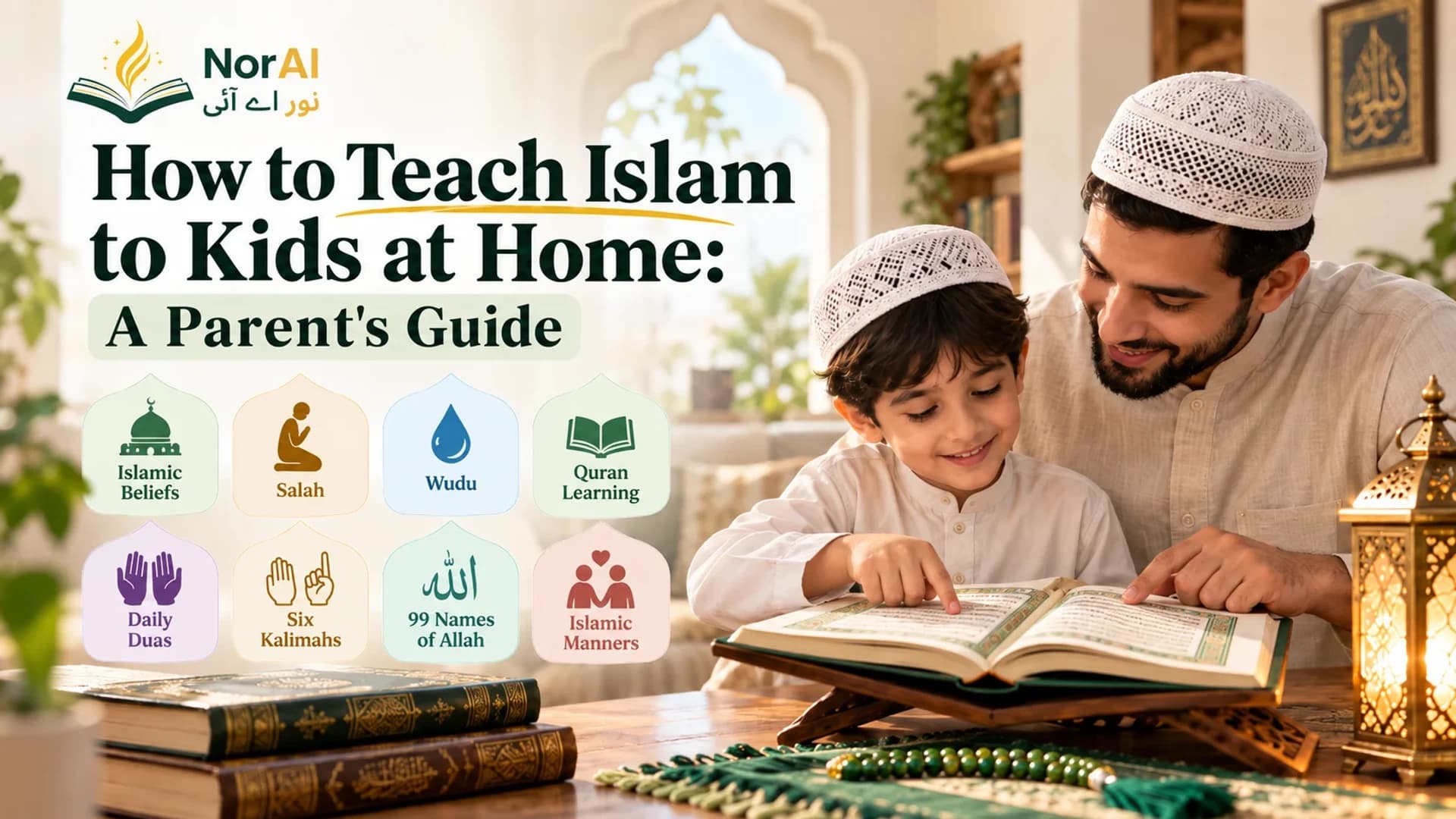
How to Teach Islam to Kids at Home: A Parent's Guide
Teaching Islam to kids at home often begins with everyday moments: hearing the Adhan, watching a parent pray, saying Bismillah before eating or asking questions about Allah. These experiences can introduce Islamic beliefs and practices long before a child is ready for formal lessons.
But many parents still wonder where to begin. Should children learn Salah first? When should they start understanding the Quran? How can Islamic learning fit around school, homework and family responsibilities?
The answer is to begin with what your child can understand and build from there. You do not need to teach every subject at once.
Quick answer: To teach Islam to kids at home, start with simple beliefs about Allah, introduce daily duas and good manners, help them become familiar with Salah and Wudu, and gradually include Quran learning. Use short conversations, practical demonstrations and regular revision. Adjust the approach to your child's age and understanding.
Key takeaways
- Begin with foundational beliefs before introducing detailed religious topics.
- Teach through everyday family routines as well as planned learning sessions.
- Introduce Salah, Wudu and daily duas through observation and guided practice.
- Explain meanings in language your child understands.
- Use trusted Islamic learning resources and seek qualified guidance for religious rulings.
- Review what your child remembers without comparing their progress with others.
How to Start Teaching Islam to Kids at Home
For most families, a useful starting point is helping children understand who Allah is, why Muslims worship Him and how Islamic teachings relate to everyday life.
Young learners often ask questions such as:
- Who is Allah?
- Why do we pray?
- What is the Quran?
- Why do we say Bismillah?
- Why should we tell the truth?
These questions give parents opportunities to introduce Islamic knowledge through conversations rather than relying entirely on memorisation.
For example, when your child asks why Muslims pray, explain that Salah is an act of worship through which Muslims remember and worship Allah.
A clear explanation suited to the child's understanding is more useful than introducing complicated terminology before they are ready.
The Quran includes guidance about family prayer in Surah Taha, 20:132, which instructs the Prophet Muhammad (peace be upon him) to direct his family towards prayer and remain patient in observing it.
For parents, patience is an important part of the learning process. Children may need to hear the same explanation many times before they understand it.
1. Teach Children About Allah and the Basics of Islamic Belief
Islamic learning begins with understanding foundational beliefs.
Parents can introduce the belief that Allah is One, that He created the world and that Muslims worship Him alone.
As children grow, they can gradually learn about the prophets, angels, revealed books, the Hereafter and other aspects of Iman.
What Islamic Beliefs Should Children Learn First?
| Topic | Beginner-friendly learning focus |
|---|---|
| Allah | Understanding that Allah is One and worthy of worship |
| Prophet Muhammad (peace be upon him) | Learning about his role as Allah's Messenger |
| The Quran | Understanding that the Quran is Allah's revelation |
| Prophets | Learning about selected prophets and their teachings |
| Angels | Becoming familiar with their place in Islamic belief |
| The Hereafter | Understanding accountability and responsibility in an age-appropriate way |
Start with one topic and let your child's questions guide the discussion.
For example, while teaching about Allah's oneness, parents can introduce the meaning of Surah Al-Ikhlas without expecting young beginners to understand detailed theological discussions.
NorAI's Islamic Beliefs learning section provides related foundational topics.
When a question involves detailed Islamic theology or a ruling, refer to qualified scholarly guidance rather than guessing.
2. Introduce Salah Through Everyday Family Life
Salah is one of the central acts of worship in Islam. For children, learning about it can begin by seeing family members pray.
Parents can explain the purpose of the five daily prayers, help children recognise their names and gradually introduce the movements and words used in Salah.
The Quran records Luqman's advice to his son, including an instruction to establish prayer, in Surah Luqman, 31:17.
How Can Parents Teach Salah at Home?
Begin with familiar experiences:
- Let your child observe family prayer when appropriate.
- Introduce the names of Fajr, Dhuhr, Asr, Maghrib and Isha.
- Explain that Muslims pray at prescribed times.
- Demonstrate basic prayer movements as the child becomes ready.
- Introduce the relevant recitations gradually, with accurate teaching.
- Review what the child understands before adding new details.
Young children may initially be more interested in observing and copying movements than understanding every part of Salah.
That is a reasonable starting point for early familiarity, but parents should gradually introduce correct practice as their child develops.
NorAI's Salah learning guide covers the five daily prayers and their learning sequence.
What Should Parents Avoid?
Avoid turning early practice into a contest or using embarrassment when children make mistakes.
At the same time, teaching the correct religious obligations matters. Parents should seek qualified guidance about the age-related responsibilities and rules concerning Salah.
The aim is to combine accurate instruction with patient teaching.
3. How to Teach Wudu to Kids at Home
Wudu is a form of ritual purification required for Salah in relevant circumstances.
Children who are beginning to learn Salah should also become familiar with Wudu and the order of its steps.
Parents can demonstrate Wudu in a practical setting and explain why purification matters in Islam.
Teaching Wudu to Kids: A Step-by-Step Approach
First, explain that Muslims perform Wudu as preparation for prayer.
Then demonstrate the steps clearly, allowing your child to observe.
When they are ready, guide them through practising the actions while supervising their use of water.
Keep the distinction between obligatory acts and recommended practices accurate according to the Islamic school being followed.
NorAI's Wudu guide introduces purification and its requirements. Families can also review Ghusl as a separate topic when age-appropriate.
Do not assume that every purification requirement can be taught through a simplified checklist alone. Some details need qualified religious explanation.
4. Make Daily Duas Part of Familiar Routines
Daily duas are among the most practical Islamic learning topics for families.
Children encounter everyday situations in which they can gradually become familiar with supplications, such as eating, sleeping, waking up and entering or leaving the home.
Instead of introducing many unfamiliar duas together, begin with one that relates to an activity your family regularly performs.
Best Daily Duas for Kids to Learn First
| Everyday situation | Suggested learning approach |
|---|---|
| Before eating | Introduce the appropriate remembrance before a meal |
| After eating | Practise the related expression of gratitude |
| Before sleeping | Introduce a suitable bedtime dua |
| After waking up | Learn a morning supplication |
| Entering or leaving the home | Practise the relevant dua when the situation occurs |
| Entering or leaving the bathroom | Learn the appropriate supplication and etiquette |
Parents can begin by reading the dua from a reliable source, explaining its meaning and allowing children to repeat it gradually.
NorAI provides a collection of 40 Daily Duas covering familiar situations.
A practical example: If your child is learning a dua before eating, practise it at mealtimes rather than relying only on a separate memorisation session.
Real-life repetition can make the words easier to remember and helps children understand when the supplication is used.
5. How to Start Teaching the Quran to Kids at Home
Quran learning is an important part of Islamic education at home, but children do not all begin at the same reading level.
Some may already recognise Arabic letters, while others are hearing Arabic recitation for the first time.
Parents should identify the child's current ability before deciding what to teach next.
Beginners can start with listening, letter recognition and basic sounds. More experienced learners may be ready for connected reading, recitation practice or recognising familiar Quranic vocabulary.
The Prophet Muhammad (peace be upon him) encouraged learning and teaching the Quran, as recorded in Sahih al-Bukhari 5027.
Practical Quran Learning Tips for Parents
A useful approach includes:
- Listening to reliable Quran recitation.
- Becoming familiar with Arabic letters and sounds.
- Practising suitable reading exercises.
- Revisiting previously learned material.
- Learning simple meanings from trustworthy resources.
- Seeking qualified guidance for accurate recitation and Tajweed.
NorAI provides a structured 20-level Quran learning curriculum, moving from Arabic foundations towards recognition, understanding, practice and review.
For recitation practice, Nazra Coach offers an Ayah-by-Ayah learning experience with listening, recitation and automated word-level feedback.
Nazra Coach is a practice aid, not a substitute for a qualified Quran teacher. Tajweed with a qualified teacher is recommended.
For parents who want a more detailed Quran-specific routine, the related blog Quran Learning for Children at Home: Parent's Checklist covers that subject separately.
6. Help Children Learn the Six Kalimahs with Understanding
The Six Kalimahs are commonly taught in South Asian Islamic education as a collection of statements involving faith, praise, Tawheed and seeking forgiveness.
They can help beginners become familiar with important expressions connected to Islamic belief.
However, the traditional six-part arrangement is an educational convention, not a numbered collection prescribed as such in the Quran or Hadith.
How Should Parents Introduce the Six Kalimahs?
Begin with the First Kalimah, explaining its meaning in simple language.
Then introduce the testimony of faith and gradually move through the remaining statements as appropriate.
Parents can encourage children to listen, repeat and understand each statement rather than simply rushing to complete all six.
NorAI's Six Kalimahs learning section provides material on the traditional sequence and meanings.
Because some of the longer Kalimahs have wording variations across educational sources, families should follow a reliable, scholar-reviewed version.
7. Teach the 99 Names of Allah Through Their Meanings
Learning the names and attributes of Allah can help children develop familiarity with how Allah is described in Islamic teaching.
Rather than beginning by asking a young child to memorise all 99 names, parents can introduce a small number with brief explanations.
For example:
- Ar-Rahman: The Most Merciful.
- Ar-Raheem: The Especially Merciful.
- Al-Aleem: The All-Knowing.
These brief meanings introduce important ideas, but they are not exhaustive explanations of Allah's names and attributes.
How Can Parents Teach Allah's Names?
Choose one name and explain its meaning using trustworthy learning material.
Review it through conversation, appropriate examples and regular reminders.
Avoid making unsupported claims about what reciting a particular name will guarantee.
Parents can use NorAI's 99 Names of Allah section as a reference for further study.
Questions about the detailed meanings or interpretation of Allah's attributes should be addressed through qualified scholarly explanations.
8. Teach Islamic Manners Through Daily Behaviour
Children learn about Islam not only through lessons but also through the behaviour they observe at home.
Parents can introduce Islamic manners through situations their children already understand.
These may include speaking respectfully, telling the truth, showing gratitude, keeping promises and treating others kindly.
Everyday Islamic Manners to Practise
| Situation | Islamic value to introduce | Parent's practical example |
|---|---|---|
| Speaking with family | Respect and kindness | Listen calmly and use respectful words |
| Making a mistake | Honesty and responsibility | Acknowledge the mistake and correct it |
| Receiving help | Gratitude | Thank the person who helped |
| Sharing belongings | Generosity | Encourage sharing appropriately |
| Disagreements | Patience and fairness | Help children listen before responding |
| Caring for the home | Responsibility | Give suitable tasks and complete them together |
Parents should also explain why these actions matter, rather than presenting good manners only as rules that must be followed.
For example, if a child admits making a mistake, acknowledge their honesty before helping them address what happened.
This can make conversations about Islamic conduct more meaningful and easier to apply.
9. How to Teach Islam to Kids of Different Ages
Children develop language, attention and understanding at different rates. There is no single home-learning schedule that suits every family.
Age can be a useful guide, but a child's existing knowledge and readiness should determine the next learning activity.
Islamic Learning Activities by Age Group
| Age group | Suitable starting focus | Parent's role |
|---|---|---|
| Ages 3–5 | Listening to Quran, simple duas, Islamic greetings and manners | Model routines and introduce brief explanations |
| Ages 6–8 | Basic beliefs, Salah familiarity, Wudu practice and Quran foundations | Guide short learning sessions and answer questions |
| Ages 9–12 | More structured Quran learning, prayer knowledge, beliefs and responsibilities | Support independent practice and clarify religious obligations |
| Ages 13+ | Deeper study, religious responsibilities, Quran learning and personal questions | Encourage informed discussion and qualified guidance |
These age bands are illustrative educational suggestions, not fixed Islamic rulings or developmental milestones.
Children who are new to Islamic learning may benefit from foundational topics regardless of their age.
Parents should also avoid assuming that familiarity with a topic means complete understanding. A learner who can recite a dua may still need help understanding its meaning or when it should be used.
10. How to Create an Islamic Learning Routine at Home
A weekly plan can help parents cover different Islamic subjects without trying to teach everything in one day.
The aim is to give each topic a manageable place in family life.
7-Day Islamic Learning Plan for Kids
| Day | Topic | Suggested home activity |
|---|---|---|
| Monday | Islamic beliefs | Discuss one simple question about Allah or the prophets |
| Tuesday | Salah | Review a prayer name, purpose or movement |
| Wednesday | Daily duas | Learn or revise one suitable dua |
| Thursday | Quran learning | Listen, read or practise according to the child's level |
| Friday | Islamic manners | Discuss honesty, kindness or gratitude |
| Saturday | Wudu or Islamic knowledge | Practise a familiar purification lesson or review beliefs |
| Sunday | Family revision | Revisit the week's topics and answer questions |
This is a suggested home routine, not a prescribed religious timetable.
For a younger beginner, one short activity may be enough. Older children may prefer more time for reading or discussion.
The routine can also change when schoolwork, family responsibilities or other commitments require it.
How Long Should Each Learning Session Be?
There is no compulsory duration for a home Islamic learning session.
A parent might begin with 10 to 15 minutes and adjust according to the child's attention, interest and existing ability.
Sometimes a short conversation during a meal or family walk may be more useful than a formal lesson.
What matters is that children have opportunities to understand, practise and revisit the material.
11. Islamic Learning Apps for Kids: Are They Worth Using?
Digital resources can help organise Islamic learning at home, especially when parents want access to structured lessons and revision activities.
However, not every learning resource provides the same level of accuracy, age suitability or parental control.
Before selecting an Islamic learning app, check whether the content comes from reliable sources and whether the learning experience suits your child.
What Makes an Islamic Learning App Suitable for Kids?
- A clearly organised learning path.
- Suitable lessons for the child's ability.
- Accurate Quranic and Islamic educational content.
- Parent-managed accounts where appropriate.
- Opportunities for listening, practice and revision.
- Clear explanations of what the app can and cannot teach.
- Appropriate privacy and safety arrangements.
NorAI supports adults and families through structured Quran learning and Islamic learning resources, including Salah, daily duas, Islamic beliefs and purification.
Its Family plan allows parents to manage minor learner profiles while continuing their own learning.
Supported offline lesson packs and audio downloads are available with relevant subscriptions, although some features require an internet connection.
Digital learning works best as part of a wider approach involving family guidance, trustworthy resources and qualified religious teaching when required.
12. Check What Your Child Understands
Parents sometimes measure progress by how many duas a child memorises or how many lessons they complete.
Those measures can be useful, but understanding and practical application matter too.
For example, a child who remembers a dua should gradually learn its meaning and the situation in which it is recited.
A child learning Salah should become familiar with both its purpose and its correct practice.
Parent's Islamic Learning Checklist
Use this checklist to review your family's learning routine.
- My child is learning Islamic beliefs at an appropriate level.
- We discuss questions about Allah and the prophets using reliable sources.
- My child is becoming familiar with the five daily prayers.
- We introduce Wudu through accurate guidance and practical demonstration.
- We practise daily duas during relevant activities.
- Quran learning matches my child's current reading ability.
- We include Islamic manners in everyday family conversations.
- We revisit earlier learning instead of introducing only new topics.
- My child feels comfortable asking questions.
- We seek qualified guidance when religious rulings or pronunciation require it.
The checklist is a tool for reviewing progress, not a list that every child must complete at the same age.
Common Mistakes When Teaching Islam to Kids at Home
Trying to teach too many subjects at once: Introducing Salah, Quran reading, detailed beliefs and several long duas together can overwhelm a beginner. Begin with manageable topics.
Focusing only on memorisation: Memorisation is useful, but children should gradually learn what the words mean and how they relate to Islamic practice.
Expecting every child to learn at the same pace: Children have different starting points. Adjust lessons to their actual understanding.
Making religious questions feel unwelcome: If a child asks something difficult, respond calmly. It is acceptable to consult a reliable source or qualified scholar rather than invent an answer.
Using digital resources without supervision: Apps can support learning, but parents should remain involved in choosing content and reviewing progress.
Confusing teaching suggestions with religious obligations: Sample timetables and age-based activities are educational recommendations. Religious responsibilities must be understood through authoritative Islamic teaching.
Frequently Asked Questions
How do I start teaching Islam to my child at home?
Begin with simple beliefs about Allah, Islamic greetings, daily duas and familiar acts of worship. Use short explanations and everyday examples before introducing more detailed subjects.
What should children learn first about Islam?
A useful starting point includes belief in Allah, familiarity with Prophet Muhammad (peace be upon him), the Quran, Salah, basic manners and everyday supplications. The exact order can depend on the child's age and knowledge.
What is the best age to start teaching Islam?
There is no single age for beginning age-appropriate Islamic learning. Parents can introduce listening, greetings, simple duas and familiar Islamic practices early, then develop structured learning as the child becomes ready. Religious obligations have separate rules.
Can parents teach Islam at home without being scholars?
Parents can introduce foundational knowledge, model Islamic manners, support revision and establish learning routines. Detailed theology, religious rulings and recitation correction may require guidance from qualified scholars or teachers.
How can I make Islamic learning interesting for kids?
Connect learning to familiar experiences. Use conversations, appropriate visual materials, listening activities, practical demonstrations and regular review. Avoid adding activities simply for entertainment when they do not support the learning objective.
How much time should children spend learning Islam each day?
There is no fixed daily duration. A short session of around 10 to 15 minutes may work as an initial routine for some beginners, but parents should adjust it according to the child's needs and attention.
Should kids learn Quran or Salah first?
Children can become familiar with both according to their readiness. Salah, Quran listening, Arabic foundations and simple beliefs can be introduced alongside one another without expecting advanced understanding immediately.
Is memorising duas enough to teach Islam?
No. Duas are one part of Islamic learning. Children should also gradually understand Islamic beliefs, Salah, Quran learning, purification, manners and the meanings of what they practise.
Can an Islamic learning app replace a teacher?
An app can support lessons, practice and revision, but it cannot replace all forms of qualified religious teaching. Direct guidance remains important for accurate recitation and questions involving religious rulings.
Building an Islamic Learning Routine That Lasts
Teaching Islam to kids at home begins with the habits and conversations children experience every day.
Parents can introduce belief in Allah, Salah, daily duas, Quran learning and Islamic manners gradually, returning to familiar topics as their child's understanding develops.
A simple plan can provide direction, but it should remain flexible enough to fit family life.
When Islamic learning combines accurate knowledge, practical experience and patient guidance, children have more opportunities to understand what they are learning and how it applies to everyday life.
Learn Quran & Islam with NorAI
Continue your family's Quran and Islamic learning journey with NorAI. Access structured lessons, interactive practice and scholar-reviewed learning content designed for adults and families.
NorAI is free to start. Download the app: