
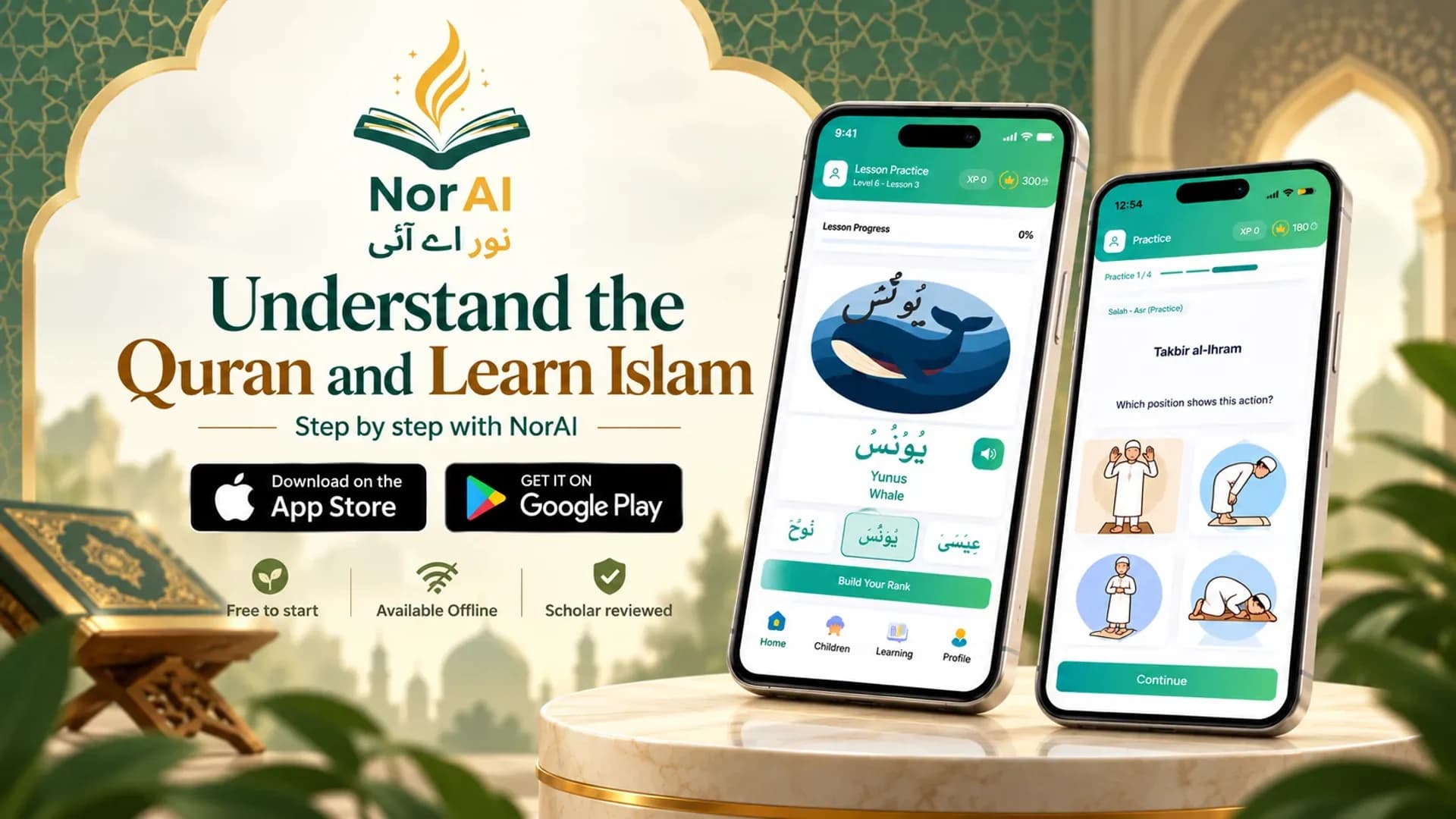
How to Understand the Quran and Learn Islam Step by Step
Understanding the Quran and learning Islam become more manageable when they are approached through a clear routine. A beginner can start with Arabic foundations and frequently used Quranic words, then build knowledge of beliefs, worship and daily Muslim life. The aim is steady understanding, supported by regular practice and review.
This does not need to happen all at once. Reading, listening, recognising words, practising Arabic writing and studying everyday Islamic teachings can develop alongside one another. The steps below provide a practical starting point for children, adults and families.
Start by separating two learning goals
Quran learning and Islamic learning are connected, but they are not the same task. Keeping the goals clear helps a learner choose the right material and measure progress more honestly.
Understanding the Quran
Understanding the Quran begins with the language and structure of the text. For a beginner, this may include recognising Arabic letters and sounds, noticing vowel marks, learning Quranic words with their meanings and seeing how familiar words appear in controlled Quranic context.
Learning Islam
Learning Islam includes beliefs, worship and guidance for daily life. A beginner may study the Six Articles of Faith, Salah, purification, daily duas, fasting, Zakat, Hajj and Umrah, the Six Kalimahs and the 99 Names of Allah. Each subject answers a different question about what Muslims believe and how worship is practised.
The two paths support each other. Quran learning helps a person recognise the words they recite, while Islamic learning provides the wider knowledge needed for faith and worship.
Step 1: Build a foundation in Arabic letters and sounds
Begin with the Arabic alphabet, letter shapes, sounds and harakat. These foundations make later word recognition easier. Learners who rush past this stage may be able to repeat a word without confidently recognising how it is formed.
Use short sessions. Focus on a small group of letters, listen to each sound, look at how the letter appears and practise writing it. Visual articulation guidance can also help a learner notice how a sound is formed. The purpose at this stage is familiarity and careful practice, not speed.
Step 2: Learn Quranic words with clear meanings
Once the foundations are in place, start learning Quranic words in small groups. See the Arabic word, listen to its recitation and connect it with a clear, scholar-reviewed meaning. Where a visual genuinely helps, it can make the meaning easier to recognise later.
Avoid collecting long vocabulary lists that are never reviewed. A smaller set of words practised in several ways is more useful than a large list seen only once. NorAI follows a structured 20-level Quran curriculum, with levels rolling out progressively, that moves from Arabic foundations towards Quranic words, recognition, connected forms and review.
Step 3: Practise the same material in different ways
Recognition becomes stronger when the learner meets the same word through more than one activity. Useful practice can include:
- seeing an image that supports the approved meaning where visual learning is suitable
- listening to the word and repeating it carefully
- following articulation guidance for Arabic sounds
- writing letters and words through guided steps
- matching a Quranic word with the correct picture
- joining letters and word parts as the curriculum progresses
- returning to learned material through regular review
These activities should support the same learning goal. They are not separate shortcuts. The learner still needs time to recognise, recall and use what has been studied.
Step 4: Move from isolated words to Quranic context
A word may be easy to recognise on a flashcard and harder to notice inside an ayah. As learners progress, they should meet familiar words in controlled Quranic context. This helps them notice pronouns, connectors, verbs and changes in word form without overwhelming them at the beginning.
At this stage, accuracy matters more than guessing. A learner should use reviewed meanings and structured lessons instead of trying to derive religious interpretation from a word alone. Vocabulary study supports Quran understanding, but it is not a substitute for qualified tafseer or scholarly guidance.
Step 5: Learn the beliefs that form the foundation of Islam
Alongside Quran learning, study the core beliefs of Islam in simple language. Start with Islam, Iman and the Shahadah, then learn the Six Articles of Faith: belief in Allah, His angels, His books, His messengers, the Last Day and divine decree.
Related vocabulary can be added gradually. The Six Kalimahs and the 99 Names of Allah may also support learning when the Arabic, transliteration and meaning are presented clearly. Understanding should come before trying to cover a large amount of material.
Step 6: Study worship in the order it is used
A practical sequence makes worship easier to understand. Purification prepares a Muslim for Salah, so Wudu and Ghusl can be studied before or alongside the five daily prayers. Salah can then be learned through its positions, sequence, recitations and the differences between Fajr, Dhuhr, Asr, Maghrib and Isha.
After this foundation, learners can study daily duas for common situations and broader acts of worship such as fasting, Zakat, Hajj and Umrah. This order connects learning with actions a Muslim may encounter at home, in the mosque and throughout the Islamic year.
Step 7: Connect learning with daily life
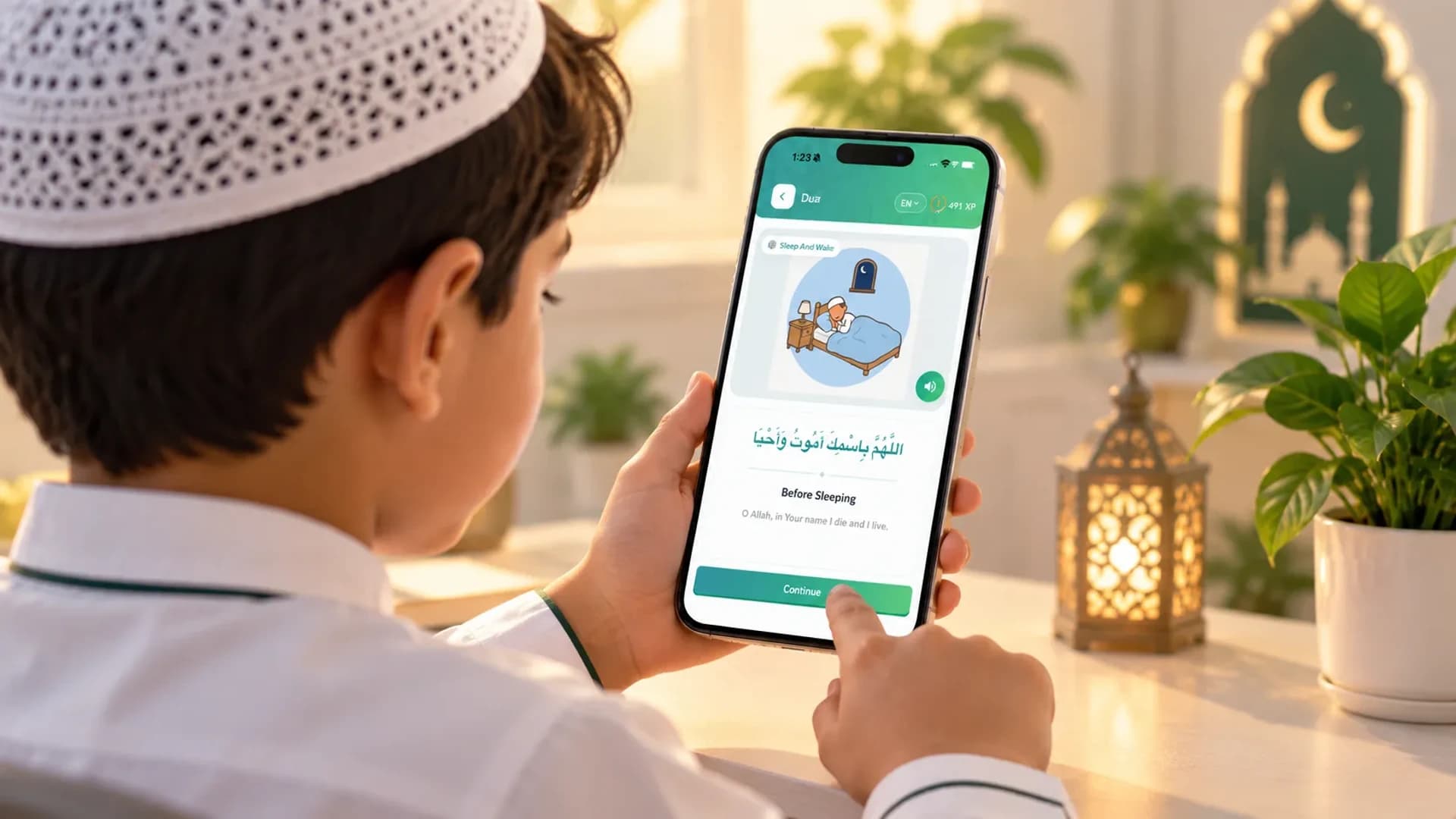
Knowledge is easier to retain when it is connected to a real moment. A learner can study a waking dua in the morning, review the steps of Wudu before Salah or listen to a daily dua before using it. Context gives the lesson a clear purpose.
Keep the connection simple. One useful dua, one Salah step or a few Quranic words may be enough for a session. The next session can begin with review before anything new is added.
Step 8: Follow a routine that allows for review
A workable routine is short enough to repeat. A short, focused session may be easier to maintain than an occasional long session. The exact pace can change according to the learner's age, confidence and available time.
How NorAI supports step-by-step learning
NorAI brings Quran learning and guided Islamic learning into one structured experience for children, adults and families. Its Quran curriculum progresses across 20 levels, beginning with Arabic foundations and moving towards Quranic words, recognition, connected forms and review.
Learners can practise through visual guidance, articulation support, audio, writing, matching and word joining. Islamic learning covers the 99 Names of Allah, daily duas, Salah, purification, fasting, Zakat, Hajj and Umrah, Islamic beliefs and the Six Kalimahs. The content is scholar-reviewed and presented through clear steps.
Individual and Family plans include supported offline lesson packs and audio downloads. Some features may require internet access.
A clear place to begin
Start with the learner's current level. If Arabic letters are unfamiliar, begin there. If the learner can read but does not recognise meanings, focus on a small group of Quranic words. For Islamic learning, choose a topic connected to daily life, such as Wudu, Salah or a daily dua.
Keep the first week simple: study a little, practise it in more than one way and review it before moving ahead. A clear sequence makes it easier to see what has been learned and what still needs attention.
Start learning with NorAI
Download NorAI on the App Store or get it on Google Play to begin with supported lessons and guided practice.
Frequently asked questions
How can I understand the Quran step by step?
Start with Arabic letters and sounds, then learn Quranic words with clear meanings. NorAI supports this step-by-step through structured lessons, audio, visual practice and regular review.
How should a beginner start learning Islam?
Begin with the Shahadah, Islam, Iman and the Six Articles of Faith. After these foundations, study purification and Salah before moving gradually to daily duas, fasting, Zakat, Hajj and Umrah, the Six Kalimahs and the 99 Names of Allah.
Can I learn Quran and Islam at the same time?
Yes. With NorAI, learners can study Quran lessons and Islamic topics together through one structured learning path.
How does NorAI help with Quran and Islamic learning?
NorAI combines Quran learning and guided Islamic learning in one structured experience. Its Quran curriculum progresses across 20 levels, while practice includes visual guidance, articulation support, audio, writing, matching and word joining. Islamic learning includes Salah, purification, daily duas, fasting, Zakat, Hajj and Umrah, Islamic beliefs, the Six Kalimahs and the 99 Names of Allah.
Is NorAI suitable for children, adults and families?
Yes. NorAI is designed for children, adults and families, with structured Quran and Islamic learning, guided practice and parent-managed learning support for families.