
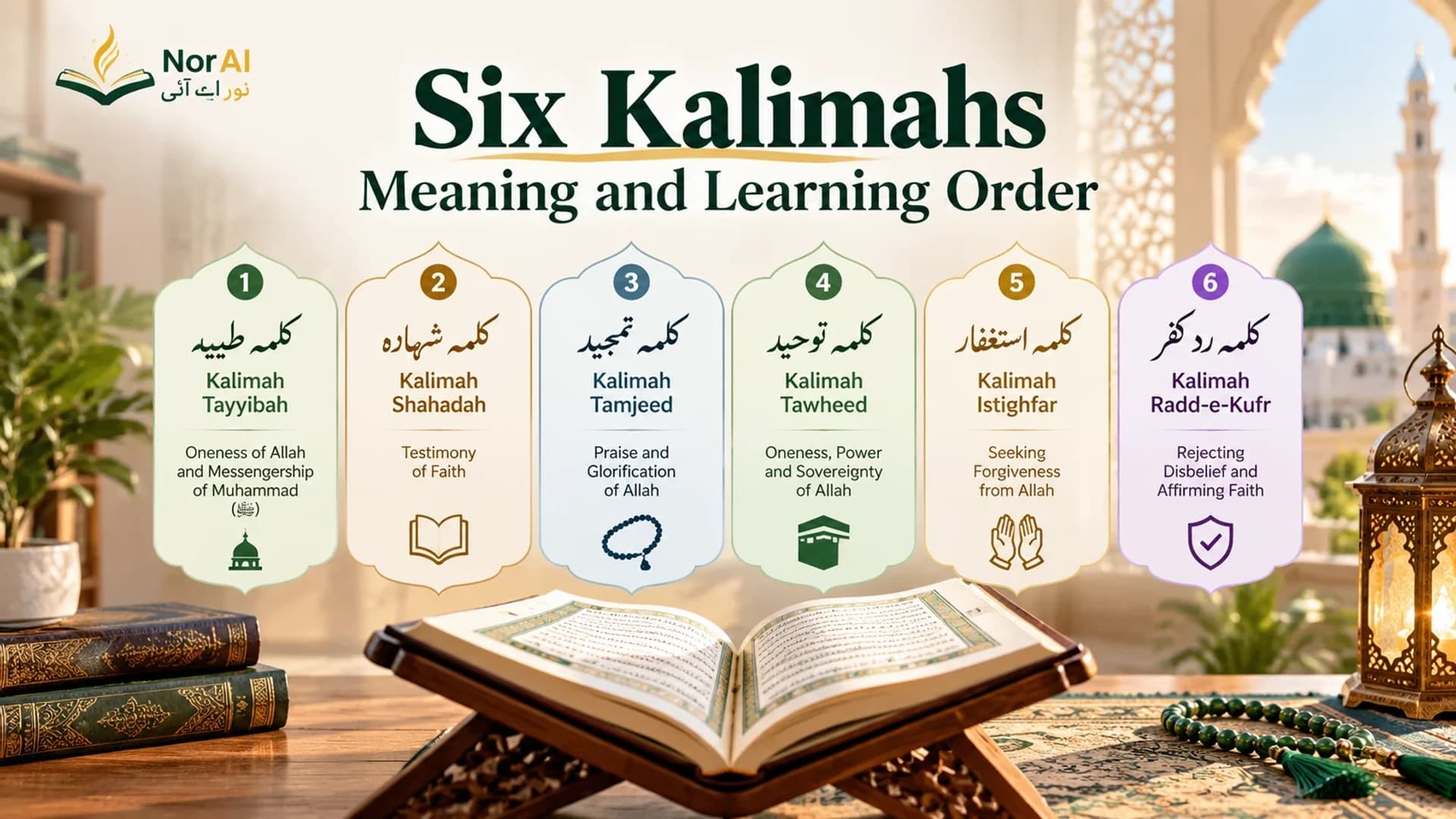
Six Kalimahs: Meaning and Learning Order
Six Kalimahs: Meaning and Learning Order
The Six Kalimahs are a familiar part of Islamic education for many Muslim families, especially in South Asia. Children often begin learning them at home or in a madrasa, while adults may return to them to improve their pronunciation and understand their meanings.
But learning the Kalimahs raises several questions. What does each Kalimah mean? Why are they taught in a particular order? Should beginners memorise the Arabic first, or understand the meaning before moving on?
This guide explains the Six Kalimahs, their commonly taught sequence and how beginners can approach learning them with understanding.
Quick answer: The traditional learning order is Kalimah Tayyibah, Kalimah Shahadah, Kalimah Tamjeed, Kalimah Tawheed, Kalimah Istighfar and Kalimah Radd-e-Kufr. These statements introduce the testimony of faith, praise of Allah, His oneness, seeking forgiveness and rejecting disbelief. Their arrangement as six Kalimahs is a teaching tradition, not a numbered sequence prescribed in the Quran or Hadith.
What Are the Six Kalimahs in Islam?
The word Kalimah comes from Arabic and means a word or statement. In traditional Islamic learning, the Six Kalimahs are commonly taught as a collection of declarations, praises and supplications connected to Islamic belief.
They introduce important ideas such as Tawheed, the oneness of Allah, the testimony of faith, remembrance and repentance.
The Six Kalimahs are particularly well known in Muslim educational traditions across Pakistan, India and Bangladesh. They may be taught through Arabic recitation, transliteration, English meanings and memorisation exercises.
Although the expressions reflect important Islamic teachings, the complete collection was not presented by the Prophet Muhammad (peace be upon him) as one prescribed set of six.
For an explanation of this distinction, see Mufti Abdur Rahman ibn Yusuf's answer on the Six Kalimahs.
Beginners should understand that the collection is a learning aid. The beliefs and acts of remembrance expressed through its statements are more important than treating the numbering itself as a religious requirement.
Six Kalimahs in Order: Names and Meanings
The following table shows the sequence commonly taught in South Asian Islamic education.
| Order | Kalimah | Common name | Main meaning |
|---|---|---|---|
| 1 | Kalimah Tayyibah | First Kalimah | Affirming Allah's oneness and Muhammad's messengership |
| 2 | Kalimah Shahadah | Second Kalimah | Bearing witness to the Islamic testimony of faith |
| 3 | Kalimah Tamjeed | Third Kalimah | Praising and glorifying Allah |
| 4 | Kalimah Tawheed | Fourth Kalimah | Affirming the oneness, power and sovereignty of Allah |
| 5 | Kalimah Istighfar | Fifth Kalimah | Seeking Allah's forgiveness |
| 6 | Kalimah Radd-e-Kufr | Sixth Kalimah | Rejecting disbelief and affirming sincere faith in Allah |
The table summarises the principal themes of each Kalimah. The complete Arabic recitations, transliterations and meanings are provided below using commonly taught versions.
1. First Kalimah: Kalimah Tayyibah
The First Kalimah is commonly called Kalimah Tayyibah, meaning the pure or good statement.
It introduces the central Islamic belief that Allah alone is worthy of worship and that Muhammad (peace be upon him) is His Messenger.
Arabic
لَا إِلَٰهَ إِلَّا اللَّهُ مُحَمَّدٌ رَسُولُ اللَّهِ
Transliteration
La ilaha illallahu Muhammadur Rasulullah.
English Meaning
There is no god worthy of worship except Allah, and Muhammad is the Messenger of Allah.
What Does the First Kalimah Teach?
The First Kalimah introduces two central beliefs:
- Allah alone is worthy of worship.
- Muhammad (peace be upon him) is the Messenger of Allah.
The Quran affirms Allah's oneness in Surah Muhammad (47:19) and identifies Muhammad as the Messenger of Allah in Surah Al-Fath (48:29).
These verses support the beliefs expressed in the statement. They should not be mistaken for a single Quranic verse containing the complete traditional First Kalimah in this exact arrangement.
How Should Beginners Learn the First Kalimah?
For beginners, the First Kalimah provides a useful starting point for learning the language of Islamic belief.
Children can begin by listening to the Arabic, repeating short portions and discussing the meaning in language appropriate to their age.
Because the statement is relatively short, learners may find it easier to recognise and revise before moving to longer Kalimahs.
2. Second Kalimah: Kalimah Shahadah
The Second Kalimah is known as Kalimah Shahadah, the testimony of faith.
It expresses the declaration that Allah alone is worthy of worship and that Muhammad (peace be upon him) is His servant and Messenger.
Arabic
أَشْهَدُ أَنْ لَا إِلَٰهَ إِلَّا اللَّهُ وَحْدَهُ لَا شَرِيكَ لَهُ وَأَشْهَدُ أَنَّ مُحَمَّدًا عَبْدُهُ وَرَسُولُهُ
Transliteration
Ashhadu an la ilaha illallahu wahdahu la sharika lahu, wa ashhadu anna Muhammadan abduhu wa rasuluh.
English Meaning
I bear witness that there is no god worthy of worship except Allah alone, with no partner, and I bear witness that Muhammad is His servant and Messenger.
What Does the Second Kalimah Teach?
The Shahadah is the testimony of faith in Islam.
It affirms belief in Allah's oneness and the messengership of Prophet Muhammad (peace be upon him).
The testimony of faith is also identified in authentic Hadith as part of the foundation of Islam.
Reference: Sahih Muslim 16c.
Although the First and Second Kalimahs express closely related beliefs, the Second Kalimah places particular emphasis on personally bearing witness to those beliefs.
How Should Beginners Learn the Second Kalimah?
Beginners can benefit from learning the meaning of Ashhadu, which means "I bear witness".
They can then learn the statement in two parts, focusing first on the declaration about Allah and then on the declaration concerning Prophet Muhammad (peace be upon him).
This helps learners understand what they are saying rather than memorising unfamiliar sounds without context.
3. Third Kalimah: Kalimah Tamjeed
The Third Kalimah is commonly called Kalimah Tamjeed.
Its central theme is praising and glorifying Allah.
The traditional recitation includes expressions of remembrance that acknowledge Allah's perfection, greatness and power.
Arabic
سُبْحَانَ اللَّهِ وَالْحَمْدُ لِلَّهِ وَلَا إِلَٰهَ إِلَّا اللَّهُ وَاللَّهُ أَكْبَرُ وَلَا حَوْلَ وَلَا قُوَّةَ إِلَّا بِاللَّهِ الْعَلِيِّ الْعَظِيمِ
Transliteration
Subhanallahi walhamdulillahi wa la ilaha illallahu wallahu akbar. Wa la hawla wa la quwwata illa billahil aliyyil azeem.
English Meaning
Glory be to Allah, and all praise belongs to Allah. There is no god worthy of worship except Allah, and Allah is the Greatest. There is no power and no strength except with Allah, the Most High, the Most Great.
What Does the Third Kalimah Teach?
Kalimah Tamjeed contains important expressions of praise and remembrance.
These include:
- Subhanallah: Glory be to Allah.
- Alhamdulillah: All praise belongs to Allah.
- La ilaha illallah: There is no god worthy of worship except Allah.
- Allahu Akbar: Allah is the Greatest.
- La hawla wa la quwwata illa billah: There is no power or strength except with Allah.
These expressions are also encountered in other parts of Islamic worship and daily remembrance.
How Should Beginners Learn the Third Kalimah?
Children can begin by learning the shorter expressions individually before combining them into the complete statement.
For adults, recognising these familiar phrases can make the longer Kalimah easier to understand.
A useful approach is to practise each expression with its meaning before reciting the complete Third Kalimah.
4. Fourth Kalimah: Kalimah Tawheed
The Fourth Kalimah is commonly known as Kalimah Tawheed.
Tawheed means affirming the oneness of Allah. It is a central belief in Islam and is reflected throughout the Quran.
Arabic
لَا إِلَٰهَ إِلَّا اللَّهُ وَحْدَهُ لَا شَرِيكَ لَهُ لَهُ الْمُلْكُ وَلَهُ الْحَمْدُ يُحْيِي وَيُمِيتُ وَهُوَ حَيٌّ لَا يَمُوتُ أَبَدًا أَبَدًا ذُو الْجَلَالِ وَالْإِكْرَامِ بِيَدِهِ الْخَيْرُ وَهُوَ عَلَىٰ كُلِّ شَيْءٍ قَدِيرٌ
Transliteration
La ilaha illallahu wahdahu la sharika lahu, lahul mulku wa lahul hamdu, yuhyi wa yumitu, wa huwa hayyun la yamutu abadan abada, dhul jalali wal ikram, biyadihil khair, wa huwa ala kulli shai'in qadeer.
English Meaning
There is no god worthy of worship except Allah. He is One and has no partner. His is the sovereignty, and all praise belongs to Him. He gives life and causes death. He is Ever-Living and never dies. He is the Possessor of Majesty and Honour. All goodness is in His hand, and He has power over all things.
What Does the Fourth Kalimah Teach?
The Fourth Kalimah affirms that Allah is One, has no partner and possesses ultimate sovereignty and power.
Its wording includes praise of Allah and acknowledgment of His control over life, death and all things.
This Kalimah develops the understanding of Allah's oneness introduced in the First and Second Kalimahs.
For related learning, NorAI's Islamic Beliefs page introduces foundational beliefs in Islam.
The Quran repeatedly affirms Allah's oneness.
For example, Surah Al-Ikhlas (112:1) states:
قُلْ هُوَ اللَّهُ أَحَدٌ
Qul huwallahu ahad.
"Say, He is Allah, One."
This verse supports the principle of Tawheed. It is a Quranic reference to the underlying belief, not a claim that the complete Fourth Kalimah appears in this verse.
How Should Beginners Learn the Fourth Kalimah?
Because the Fourth Kalimah is longer, learners can divide it into sections.
Begin with the declaration of Allah's oneness, then continue with the phrases describing His sovereignty, power and attributes.
Understanding these meanings can help learners recognise the connection between the Kalimah and what the Quran teaches about Allah.
5. Fifth Kalimah: Kalimah Istighfar
The Fifth Kalimah is known as Kalimah Istighfar.
Istighfar means seeking forgiveness from Allah.
The traditional Fifth Kalimah is a longer supplication that includes acknowledging wrongdoing and asking Allah for forgiveness.
Arabic
أَسْتَغْفِرُ اللَّهَ رَبِّي مِنْ كُلِّ ذَنْبٍ أَذْنَبْتُهُ عَمَدًا أَوْ خَطَأً سِرًّا أَوْ عَلَانِيَةً وَأَتُوبُ إِلَيْهِ مِنَ الذَّنْبِ الَّذِي أَعْلَمُ وَمِنَ الذَّنْبِ الَّذِي لَا أَعْلَمُ إِنَّكَ أَنْتَ عَلَّامُ الْغُيُوبِ وَسَتَّارُ الْعُيُوبِ وَغَفَّارُ الذُّنُوبِ وَلَا حَوْلَ وَلَا قُوَّةَ إِلَّا بِاللَّهِ الْعَلِيِّ الْعَظِيمِ
Transliteration
Astaghfirullaha rabbi min kulli dhanbin adhnabtuhu amadan aw khata'an, sirran aw alaniyatan, wa atubu ilaihi minadh-dhanbilladhi a'lamu wa minadh-dhanbilladhi la a'lamu. Innaka anta allamul ghuyubi wa sattarul uyubi wa ghaffarudh-dhunubi, wa la hawla wa la quwwata illa billahil aliyyil azeem.
English Meaning
I seek forgiveness from Allah, my Lord, for every sin I have committed, deliberately or by mistake, secretly or openly. I turn to Him in repentance for the sins I know and the sins I do not know. Indeed, You are the Knower of the unseen, the Concealer of faults and the Forgiver of sins. There is no power and no strength except with Allah, the Most High, the Most Great.
What Does the Fifth Kalimah Teach?
Its main themes include:
- Recognising that people can make mistakes.
- Seeking Allah's forgiveness for sins.
- Turning sincerely towards Allah in repentance.
- Acknowledging Allah's mercy.
An important Quranic reference to seeking forgiveness appears in Surah Nuh (71:10), where Prophet Nuh calls his people to seek forgiveness from their Lord.
The Quranic verse teaches the importance of Istighfar, although it is not the complete wording of the traditional Fifth Kalimah.
How Should Beginners Learn the Fifth Kalimah?
Because the Fifth Kalimah is longer than the first two, beginners may find it easier to divide the Arabic recitation into smaller sections.
Listen to one section, repeat it carefully and review its meaning before continuing.
Parents should also explain that Istighfar is about sincerely seeking forgiveness, not simply completing a memorisation exercise.
6. Sixth Kalimah: Kalimah Radd-e-Kufr
The Sixth Kalimah is commonly called Kalimah Radd-e-Kufr.
Its name refers to rejecting disbelief.
The traditional statement includes seeking Allah's protection from associating partners with Him, turning away from disbelief and affirming sincere belief in Allah.
Arabic
اللَّهُمَّ إِنِّي أَعُوذُ بِكَ مِنْ أَنْ أُشْرِكَ بِكَ شَيْئًا وَأَنَا أَعْلَمُ بِهِ وَأَسْتَغْفِرُكَ لِمَا لَا أَعْلَمُ بِهِ تُبْتُ عَنْهُ وَتَبَرَّأْتُ مِنَ الْكُفْرِ وَالشِّرْكِ وَالْكِذْبِ وَالْغِيبَةِ وَالْبِدْعَةِ وَالنَّمِيمَةِ وَالْفَوَاحِشِ وَالْبُهْتَانِ وَالْمَعَاصِي كُلِّهَا وَأَسْلَمْتُ وَأَقُولُ لَا إِلَٰهَ إِلَّا اللَّهُ مُحَمَّدٌ رَسُولُ اللَّهِ
Transliteration
Allahumma inni a'udhu bika min an ushrika bika shai'an wa ana a'lamu bihi, wa astaghfiruka lima la a'lamu bihi. Tubtu anhu wa tabarra'tu minal kufri wash-shirki wal-kidhbi wal-ghibati wal-bid'ati wan-namimati wal-fawahishi wal-buhtani wal-ma'asi kulliha, wa aslamtu wa aqulu la ilaha illallahu Muhammadur Rasulullah.
English Meaning
O Allah, I seek refuge in You from knowingly associating anything with You, and I seek Your forgiveness for what I do not know. I repent and reject disbelief, associating partners with Allah, lying, backbiting, religious innovations, spreading malicious gossip, indecency, false accusations and all sins. I submit to You and declare that there is no god worthy of worship except Allah, and Muhammad is the Messenger of Allah.
What Does the Sixth Kalimah Teach?
Its principal themes include:
- Rejecting Shirk, the association of partners with Allah.
- Seeking Allah's forgiveness and protection.
- Affirming belief in Allah.
- Rejecting disbelief and false religious claims.
The Sixth Kalimah is often longer than the earlier statements, so learners may need additional time to become familiar with its wording.
It should be taught as a statement concerning the learner's own faith and beliefs, without using it to make accusations about other people.
How Should Beginners Learn the Sixth Kalimah?
Start with the key terms.
Explain what is meant by belief in Allah, sincerity and seeking forgiveness.
Because the Sixth Kalimah is lengthy, learners can divide it into shorter sections and review each section's meaning before continuing.
As with the Fifth Kalimah, the complete Arabic wording should be checked against a reliable educational source and reviewed by a qualified teacher or scholar before memorisation.
What Is the Best Order to Learn the Six Kalimahs?
The traditional learning sequence begins with Kalimah Tayyibah and continues through Shahadah, Tamjeed, Tawheed, Istighfar and Radd-e-Kufr.
This order can provide a clear structure for beginners, particularly when the statements are introduced gradually.
However, the sequence is an educational convention. It should not be described as a compulsory order established in the Quran or Hadith.
Suggested Learning Order for Beginners
| Stage | What to learn | Learning focus |
|---|---|---|
| 1 | First Kalimah | Basic declaration of faith |
| 2 | Second Kalimah | Testimony of faith and its meaning |
| 3 | Third Kalimah | Expressions of praise and remembrance |
| 4 | Fourth Kalimah | Understanding Tawheed |
| 5 | Fifth Kalimah | Seeking forgiveness |
| 6 | Sixth Kalimah | Affirming faith and rejecting disbelief |
| 7 | Revision | Reviewing all six statements and their meanings |
This sequence offers a practical way to organise learning.
It is not necessary to assign the same number of days to every Kalimah. Shorter statements may be learned more quickly, while longer ones may need additional revision.
The goal is to develop familiarity with the words and their meanings at a manageable pace.
How Can Children Learn the Six Kalimahs at Home?
Many parents introduce the Six Kalimahs as part of their children's early Islamic education.
A simple routine can help make practice consistent without placing unnecessary pressure on the child.
A Practical Learning Routine
1. Begin with listening
Let your child hear a reliable Arabic recitation of the Kalimah being studied.
2. Divide longer statements into sections
Smaller parts may be easier to repeat and recognise than an entire long statement.
3. Explain the meaning
Use clear, age-appropriate language. For example, while teaching the First Kalimah, explain that Muslims believe Allah alone is worthy of worship.
4. Practise pronunciation
Encourage careful listening and repetition. If you are unsure about an Arabic sound, ask a qualified teacher rather than guessing.
5. Review before moving forward
Give your child opportunities to remember previously learned material before introducing another Kalimah.
Parents can also explore NorAI's Daily Duas section to introduce other supplications and expressions used in everyday Islamic learning.
These are separate learning materials and should not be confused with the Six Kalimahs themselves.
Should Beginners Memorise the Arabic or Learn the Meaning First?
Both pronunciation and understanding deserve attention.
Learning the Arabic helps a person become familiar with the traditional words, while learning the meaning helps them understand the beliefs, praises and supplications being expressed.
Beginners do not have to master both at once.
A learner may begin by listening to the Arabic and understanding its general meaning, then gradually improve pronunciation and memorisation.
Arabic, Transliteration and Meaning: What Is the Difference?
| Learning format | What it provides | Main limitation |
|---|---|---|
| Arabic text | The original script of the statement | Requires familiarity with Arabic letters |
| Transliteration | A reading aid using Latin letters | May not represent every Arabic sound accurately |
| English meaning | Explains the statement's message | Does not replace the Arabic wording |
| Audio recitation | Demonstrates how the statement sounds | May still require teacher guidance for pronunciation |
Using these formats together can support learning, especially for beginners who are still developing Arabic reading skills.
For broader Quran learning, NorAI provides a structured 20-level curriculum that introduces Arabic recognition, understanding and practice progressively.
The Quran curriculum and the Six Kalimahs are distinct learning subjects, but familiarity with Arabic letters and sounds can support both.
Common Mistakes When Learning the Six Kalimahs
Learning the Six Kalimahs should involve more than completing a memorisation list.
Some common difficulties include:
Memorising without understanding: A learner may be able to repeat a statement while remaining unfamiliar with its meaning. Reviewing both can help.
Relying entirely on transliteration: Latin letters cannot always represent Arabic pronunciation precisely. Audio and qualified guidance remain useful.
Moving through the sequence too quickly: Longer statements may require more practice. There is no need to rush.
Confusing the collection with a Quranic chapter: The Six Kalimahs are not a surah or a single numbered passage in the Quran.
Assuming all six are required for accepting Islam: The Shahadah is the testimony of faith. Memorising the complete traditional set of Six Kalimahs is not a separate condition for becoming Muslim.
Treating every version as identical: Some educational materials differ slightly in wording or transliteration. Learners should follow a reliable, reviewed text and avoid combining different versions unintentionally.
A steady routine, accurate source material and an understanding of the meanings can make learning clearer.
Frequently Asked Questions
What are the Six Kalimahs in Islam?
The Six Kalimahs are a traditional collection of Islamic statements and supplications commonly taught in South Asian Muslim education. They cover the testimony of faith, praise of Allah, Tawheed, seeking forgiveness and rejecting disbelief.
What are the names of the Six Kalimahs in order?
The common sequence is Kalimah Tayyibah, Kalimah Shahadah, Kalimah Tamjeed, Kalimah Tawheed, Kalimah Istighfar and Kalimah Radd-e-Kufr.
Are the Six Kalimahs mentioned together in the Quran?
No. The Quran does not present the Six Kalimahs as a numbered collection. Their underlying beliefs and several expressions are supported by the Quran and Hadith, but the six-part teaching arrangement developed as an educational tradition.
Is it compulsory to memorise all Six Kalimahs?
Memorising the Six Kalimahs as a complete numbered collection is not an independent religious obligation. However, learning the testimony of faith and understanding foundational Islamic beliefs are important. Religious responsibilities should not be confused with a particular teaching format.
Which Kalimah should a beginner learn first?
In the traditional sequence, beginners start with Kalimah Tayyibah. It introduces belief in Allah's oneness and Muhammad's messengership. The Shahadah should also be understood clearly because of its central place in Islam.
What is the difference between the First and Second Kalimah?
The First Kalimah expresses the central declaration of belief. The Second Kalimah is the testimony of faith, in which the speaker explicitly bears witness that Allah alone is worthy of worship and that Muhammad is His servant and Messenger.
Can children learn the Six Kalimahs using English transliteration?
Transliteration can help children recognise unfamiliar Arabic words, but it should be treated as a temporary reading aid. Learning Arabic letters, listening to reliable recitation and receiving pronunciation guidance can improve accuracy.
How long does it take to learn all Six Kalimahs?
There is no fixed duration. The time needed depends on the learner's age, Arabic familiarity, pronunciation ability and opportunities for revision. Longer statements may require more practice than the shorter ones.
Are all Six Kalimahs part of the Shahadah?
No. The Shahadah is the testimony of faith. The traditional Six Kalimahs include additional statements of praise, Tawheed, repentance and rejection of disbelief.
Learning the Six Kalimahs with Understanding
The Six Kalimahs offer a familiar way for beginners to study important statements connected to Islamic belief and remembrance.
Their commonly taught order begins with the declaration of faith and moves towards expressions of praise, Tawheed, forgiveness and the rejection of disbelief.
For parents, children and adult learners, the most useful approach is to learn carefully, understand the meanings and revisit the statements regularly.
The traditional sequence can support that process, while reliable Arabic texts and qualified religious guidance help ensure that what is learned is accurate.
Learn Quran & Islam with NorAI
Continue your Quran and Islamic learning journey with NorAI. Explore structured lessons, interactive practice and scholar-reviewed learning content designed for adults and families.
NorAI is free to start. Download the app: