
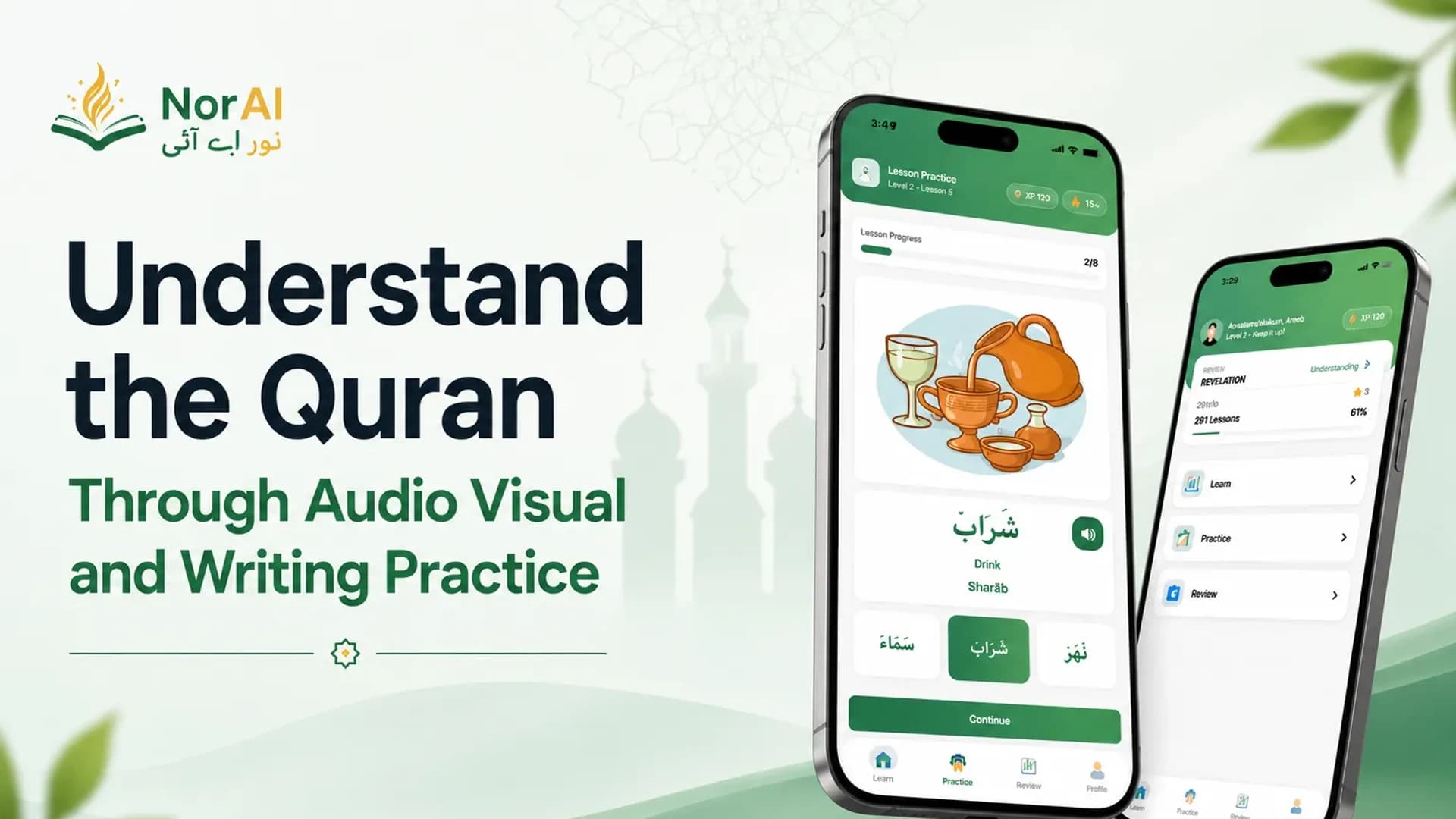
Understand the Quran Through Audio Visual and Writing Practice
Understanding the Quran becomes easier when Quranic Arabic is not approached through reading alone. Learners often need to see a word, hear it clearly, connect it with its meaning, and become familiar with how it is written.
NorAI brings these learning experiences together through Audio Practice, Visual Learning, and Writing Practice. Each practice type supports the same goal: helping learners build stronger recognition and understanding of Quranic Arabic words.
Instead of depending on one method, learners interact with Quranic vocabulary in different ways. This gives each word more opportunities to become familiar over time.
Visual Learning Supports Word Recognition
For a beginner, an unfamiliar Quranic Arabic word can be difficult to remember when it appears only as text.
Visual Learning provides additional support by helping learners connect selected Quranic words with clear visual references. The Arabic word remains the main focus, while the visual helps make the meaning easier to recognise and remember.
When a learner sees the same word again during practice, the visual connection can help bring its meaning back to mind.
This creates a simple learning pattern:
See the Quranic word, understand its meaning, and recognise it again later.
Visual Learning is especially useful when learners are still building their first connections with Quranic vocabulary. It makes the learning experience more active without replacing the original Arabic word.
Over time, the learner becomes less dependent on the visual support as the word itself becomes more familiar.
Audio Practice Connects the Word With Its Sound
Quranic Arabic is not only seen on a page. It is also heard during recitation.
Audio Practice helps learners connect the written Quranic word with the way it sounds. Hearing a word clearly can strengthen recognition and make it easier to notice when the same word appears again.
A learner may already recognise a word visually but still struggle to identify it when hearing it. Audio Practice gives that learner another way to work with the same vocabulary.
The learner can see the Arabic word, listen to its audio, and connect the sound with the approved meaning.
This creates a stronger relationship between what the learner sees and what they hear.
Repeated listening can also make Quranic words feel less unfamiliar. When learners hear the same vocabulary again during future practice, recognition can gradually become faster and more natural.
Writing Practice Builds Familiarity With Arabic Forms
Writing Practice adds another important layer to Quranic Arabic learning.
Looking at an Arabic word and writing Arabic are different experiences. When learners practise writing, they have to pay closer attention to letter shapes and written forms.
NorAI uses guided Writing Practice to help learners become more familiar with Arabic letters and their forms.
Instead of simply asking the learner to copy unfamiliar Arabic, the writing activity provides guidance that supports the practice process.
This can help learners notice details they might miss while only reading.
They begin paying more attention to how letters look, how forms are shaped, and how written Arabic appears.
Writing Practice does not turn the learning experience into a handwriting course. Its purpose is to support familiarity with the Quranic Arabic forms learners are studying.
Visual, Audio and Writing Practice Support the Same Word
The strength of these practice types comes from how they work together.
A Quranic word does not need to be learned through only one activity.
A learner may first encounter the word visually and connect it with its meaning.
Later, the learner can hear the same word during Audio Practice.
Writing Practice can then help the learner pay closer attention to its Arabic form.
Each activity approaches the word differently, but the learning goal remains the same.
The learner is building familiarity with the Quranic word.
This repeated interaction can make recognition stronger than seeing the word once and moving on immediately.
Seeing a Word Can Help Build the First Connection
Visual recognition is often the first step in becoming familiar with a new Quranic word.
When learners see the Arabic form together with a clear visual reference, they receive an additional clue about what the word means.
At the beginning, this support can make new vocabulary feel easier to approach.
With repeated practice, the learner starts recognising the Arabic word itself rather than depending only on the supporting visual.
The visual therefore acts as a bridge.
It helps the learner move from an unfamiliar Quranic word toward stronger independent recognition.
Hearing a Word Adds Another Form of Recognition
After seeing a word, hearing it can deepen familiarity.
The same word now has both a visual form and a sound.
This matters because Quranic words are frequently encountered through recitation. A learner who only recognises a word on screen may not immediately notice it when hearing it.
Audio Practice helps reduce that gap.
By repeatedly hearing studied words, learners can start connecting familiar sounds with familiar Arabic forms.
A word that once sounded unfamiliar can gradually become recognisable.
This helps the learner build a connection between reading and listening without changing the focus from Quranic vocabulary.
Writing Makes the Learner Work More Actively With the Word
Writing requires more active attention than simply looking at a word.
The learner has to follow the written form instead of only observing it.
This can help reinforce details such as letter shapes and the overall appearance of Arabic forms.
For beginners, this active involvement can support stronger familiarity.
Writing Practice gives learners time to slow down and notice what they are working with.
Rather than quickly moving past an Arabic form, they interact with it more carefully.
That extra attention can support recognition when the same form appears later.
Repetition Across Different Practice Types Matters
A learner may understand a word during one activity and still forget it later.
That is normal when learning new vocabulary.
Recognition becomes stronger when a word returns multiple times.
Audio, Visual, and Writing Practice allow the same Quranic vocabulary to be revisited in different ways.
Instead of repeating exactly the same activity every time, the learner can experience the word through another format.
This keeps the focus on the same Quranic word while changing how the learner interacts with it.
Repeated exposure can gradually turn an unfamiliar word into a familiar one.
Different Learners May Benefit From Different Practice Types
Not every learner responds to the same type of practice in the same way.
Some learners may remember a Quranic word more easily after seeing a visual reference.
Others may find that hearing the word helps them recognise it faster.
Some learners may need to work with the written form before it becomes familiar.
Using Audio, Visual, and Writing Practice together allows learners to interact with Quranic Arabic from more than one direction.
The learner is not forced to depend entirely on one method.
Instead, each activity contributes to the same understanding process.
The Goal Is Quranic Word Understanding
These practice types are not included simply to create variety.
Their purpose is to help learners become more familiar with Quranic Arabic words and their meanings.
Visual Learning supports the connection between the word and its meaning.
Audio Practice strengthens the connection between the written word and its sound.
Writing Practice develops familiarity with the Arabic form.
Together, they help learners work more actively with the Quranic vocabulary they are studying.
The focus remains on understanding Quranic words rather than completing activities for their own sake.
Building Familiarity Takes Time
Quranic Arabic vocabulary is unlikely to become familiar after one encounter.
Some words may be remembered quickly, while others need more repetition.
Audio, Visual, and Writing Practice give learners multiple opportunities to return to the same learning material.
A word may first feel completely unfamiliar.
After seeing it several times, the shape becomes recognisable.
After hearing it repeatedly, the sound becomes familiar.
After working with its written form, the learner may notice details that were previously missed.
These small improvements build gradually.
From Unfamiliar Words to Stronger Recognition
The purpose of repeated practice is not to rush the learner.
It is to make Quranic words increasingly familiar.
At first, the learner may need visual support.
Later, the Arabic word itself becomes easier to recognise.
At first, the audio may sound unfamiliar.
After repeated listening, the learner can begin recognising the sound.
Writing can reinforce the visual structure of the Arabic form.
Each small improvement contributes to stronger Quranic word recognition.
A More Active Way to Understand the Quran
Understanding the Quran can begin with simple interactions with its words.
See the word.
Connect it with its meaning.
Hear the word.
Become familiar with its sound.
Practise the written form.
Recognise it again.
Audio, Visual, and Writing Practice support this process by giving learners different ways to interact with Quranic Arabic without changing the core learning goal.
Each activity reinforces familiarity from a different direction.
Over time, the learner can move from seeing unfamiliar Arabic words to recognising more of the Quranic vocabulary they have practised.
That gradual recognition is what helps make Quranic Arabic learning more meaningful, active, and easier to continue.