
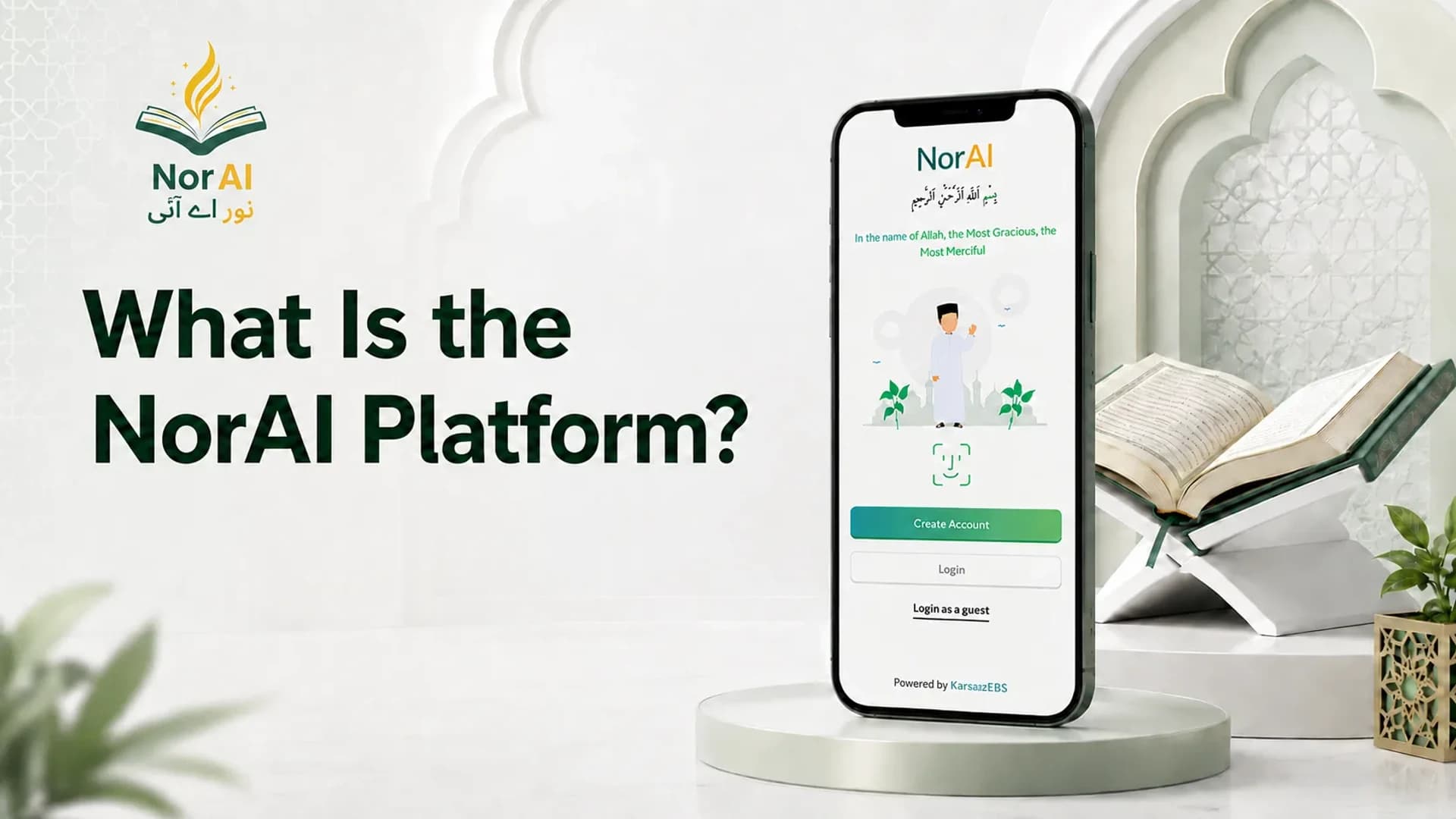
What Is the NorAI Platform? A Complete Overview
NorAI is a Quranic Arabic learning platform that helps children, adults and families understand Quranic words one at a time. It combines a structured curriculum with visual learning, recitation audio, articulation guidance, guided writing and regular revision.
The platform is designed for people who may be able to read or recite the Quran but still depend on a translation to understand many of its Arabic words. Instead of presenting a long vocabulary list, NorAI introduces words progressively and returns to them through different forms of practice.
The NorAI curriculum is structured across 20 levels and is rolling out progressively. Learners begin with Arabic letters, sounds and harakat before moving towards Quranic vocabulary, word recognition and the identification of familiar words within Quranic verses.
NorAI is available on iOS and Android. Learners can start for free, while paid Individual and Family plans provide access to additional lessons, progress tools and supported offline downloads.
What does NorAI teach?
NorAI focuses on Quranic Arabic vocabulary, word meanings and recognition. Learners study how a Quranic word looks, what it means, how it sounds and how it appears within the Quran.
The curriculum covers:
- Arabic letters, sounds and harakat
- Quranic nouns, verbs, pronouns and particles
- Quranic word meanings in simple English and Urdu
- Visual support for understanding vocabulary
- Recitation audio
- Articulation guidance
- Guided Arabic writing
- Quizzes and recognition practice
- Previously studied words within Quranic verses
- Structured revision and word-mastery tracking
NorAI does not provide tafseer, fatwa, theological rulings or AI-generated Quranic interpretations. It also does not teach Tajweed. Its audio and articulation features support word-level pronunciation practice, but Tajweed and correct recitation should be studied with a qualified teacher.
A structured Quranic Arabic curriculum
NorAI provides a clear learning path from basic Arabic recognition to a stronger understanding of Quranic vocabulary.
The complete curriculum covers more than 2,000 scholar-reviewed Quranic words, which are introduced progressively as the learning content rolls out. These words are organised into four main categories: nouns, verbs, pronouns and particles.
A learner first meets a word through its written form, visual support, meaning and audio. The word then returns through guided practice and later revision.
The curriculum is organised around four broad stages.
Foundation
The opening levels introduce Arabic letters, their sounds and harakat. Learners become familiar with the basic elements of written and spoken Arabic before moving towards a wider range of Quranic vocabulary.
This stage gives beginners the recognition skills needed for the later parts of the curriculum.
Understanding
The next stage introduces Quranic words with their meanings, visuals, audio and pronunciation support.
Learners see how a word is written, listen to its audio and connect it with a clear meaning. Studying the same word in several ways supports later recognition.
Practice
Previously studied words return through quizzes, recognition activities, writing practice and structured review.
Learners also begin identifying familiar words within Quranic verses. This helps them move from recognising vocabulary during a lesson to noticing the same vocabulary in Quranic text.
Completion
The later part of the curriculum focuses on stronger word recognition, revision and reading confidence. Learners continue meeting familiar vocabulary in different lessons and Quranic verses.
Learners who complete all 20 levels may receive a programme completion certificate. The certificate reflects completion of the NorAI curriculum and the learner’s Quranic vocabulary progress. It is not a religious qualification or scholarly certification.
Twenty structured learning levels
NorAI divides its curriculum into 20 levels so learners have a clear sequence to follow.
The first five levels establish the foundations of Arabic letters, sounds and harakat. The following levels progressively introduce Quranic words, meanings, pronunciation and repeated practice. Later lessons help learners recognise studied words within Quranic verses.
The 20-level curriculum is being made available progressively. Paid plans provide access to all lessons that are available at the time.
NorAI does not impose a fixed completion deadline. Learners can repeat activities, return to earlier vocabulary and move through the curriculum according to their own pace.
The practice flow can also change according to the learner’s progress. When a learner needs more support, fewer new words may be introduced and familiar words may return more often. As recognition improves, additional vocabulary is introduced gradually.
Six ways to practise Quranic words
NorAI uses six connected practice methods. Each one helps learners understand, recognise or remember Quranic words in a different way.
Visual learning
Clear visuals help learners connect Quranic words with their meanings. Each image provides a simple clue for understanding unfamiliar vocabulary.
This method can be especially helpful for children, beginners and learners who remember words more easily through pictures.
Match quiz
Match quizzes ask learners to connect Quranic words with the correct pictures. This reinforces the meaning of each word through active practice.
Repeated matching also helps learners recognise previously studied vocabulary more confidently.
Articulation guidance
Articulation guidance shows learners how Arabic letter sounds are formed. It draws attention to pronunciation details that written Arabic alone may not explain clearly.
This feature supports pronunciation practice but does not replace Tajweed instruction or guidance from a qualified teacher.
Recitation audio
Recitation audio allows learners to hear Quranic words and repeat them during practice. Listening connects each word’s written form with its pronunciation.
Regular audio practice can also help learners recognise familiar words when they hear them during Quran recitation.
Guided writing
Guided writing helps learners practise Arabic letter shapes and movements. Step-by-step instructions make unfamiliar letters and words easier to follow.
Writing also provides a practical way to become more familiar with the form of Quranic Arabic words.
Word joining
Word joining becomes available at Level 16. Learners combine letters and word parts to build complete Quranic words.
This activity helps learners understand how separate Arabic forms connect to create a complete word.
How a NorAI lesson works
NorAI lessons follow a familiar learning sequence so learners know what comes next.
A learner first sees and hears a Quranic word. The word is then connected with its meaning before the learner moves into quizzes, recognition exercises or guided writing.
Depending on the lesson, learners may:
- Learn a new Quranic word
- Connect the word with its meaning
- Practise through quizzes
- Recognise or match previously studied words
- Follow guided Arabic writing steps
- Identify a studied word within a Quranic verse
- Review the word again over time
A studied word does not disappear after one lesson. It returns through the revision system, giving the learner further opportunities to recognise and remember it.
Smart revision and word mastery
Completing a lesson does not necessarily mean that every word has been remembered. NorAI therefore tracks lesson completion and vocabulary mastery separately.
Progress shows where the learner has reached in the curriculum. Mastery reflects how well an individual word has been remembered over time.
Each word moves through four learning stages.
New
The word has been introduced for the first time and enters the learner’s practice queue.
Learning
The learner has answered correctly at least once. The word continues to appear regularly across different forms of practice.
Review
The word has become more familiar but still returns periodically. The gaps between its appearances may increase as the learner remembers it more consistently.
Mastered
The learner has recalled the word correctly across multiple sessions on different days. The word then appears less frequently, although it may still return during later revision.
Words that need more attention can return more often, while better-known words appear less frequently. This keeps revision connected to the learner’s actual recall.
Noor a calm learning companion
Noor is an animated light within NorAI that reflects learning consistency. It is not a character, academic score or public ranking.
When a learner practises regularly, Noor becomes brighter. If the learner takes a break, it dims quietly without warnings, guilt-based messages or penalties.
Noor reflects engagement rather than academic performance. NorAI does not use public leaderboards or comparisons between learners, so Quranic Arabic learning remains calm and non-competitive.
Progress tracking
NorAI helps learners distinguish between finishing a lesson and retaining its vocabulary.
Depending on the selected plan, progress information may include:
- Completed lessons and levels
- Current curriculum position
- Recently practised vocabulary
- Words moving through the mastery stages
- Retained Quranic words
- Recent learning activity
- Vocabulary grouped by category
This gives learners and parents a clearer view of what has been covered and which words are being remembered over time.
Progress and word-mastery tracking are included with paid Individual and Family plans. They are not included in the current Free plan.
NorAI for families
The NorAI Family Plan includes Parent Mode and supports one parent profile with up to four parent-managed minor learner profiles.
Each learner has a separate learning path, progress record and vocabulary history. Learning data is not mixed between profiles.
Through the Family dashboard, parents can view information such as:
- Weekly learning summaries
- Completed lessons
- Retained vocabulary
- Progress compared with mastery
- Vocabulary grouped by category
- Recent learning activity
- The learner’s current curriculum position
This allows parents to follow their child’s learning without needing to monitor every lesson directly.
A parent-managed experience for children
NorAI separates the learner experience from billing and subscription management.
Minor learners do not have independent accounts and cannot access payment, billing or subscription settings. These areas remain under the control of the parent or guardian.
A parent-managed minor learner profile may include a display or learner name, gender and date of birth. NorAI does not collect a child’s email address, phone number, GPS location, voice recordings, biometric information, payment information, device contacts or social-network information.
The learner experience does not include advertisements, visible pricing or subscription pressure. NorAI also does not provide public child profiles, public messaging, child-to-child chat or open social-networking features.
NorAI is designed for learners aged five and above. Younger learners may still need support from a parent or guardian while using the app.
NorAI for adults and independent learners
NorAI is not limited to children. Adults and independent learners can follow the same underlying curriculum at their own pace.
Someone who can recite the Quran but understands only some of its Arabic vocabulary can use the lessons to build word recognition gradually.
There are no public rankings, timers or fixed completion deadlines. Learners can revisit earlier vocabulary, repeat activities and continue when they are ready.
Offline Quranic Arabic learning
Offline lesson packs and supported audio downloads are available through NorAI’s paid Individual and Family plans.
Once an eligible lesson pack has been downloaded, its lessons, audio and practice activities can remain available without an active internet connection.
Learning progress may be stored locally on the device. When connectivity returns, the progress may synchronise with NorAI’s services.
Offline access can be useful during travel or in places where internet access is unreliable. An internet connection is still required for the initial download and for certain account, subscription, backup and synchronisation functions.
Scholar-authored and reviewed content
NorAI’s Quranic words and meanings are written and reviewed by qualified Islamic scholars. Artificial intelligence does not generate its Quranic meanings, translations or religious explanations.
The scholarly team includes the following members.
Maulana Hazrat Ali
As Quranic Content Development Scholar, Maulana Hazrat Ali prepares Quranic learning material, including Quranic vocabulary, Arabic-language presentation and simple Urdu and English meanings.
Shaykh Zia ul Islam
As Quranic Content Verification Scholar, Shaykh Zia ul Islam independently reviews the prepared material. His work includes checking Quranic vocabulary, Urdu and English meanings, consistency and beginner-level clarity.
Syed Imam Alam Khan
As Quranic Audio Review and Approval Scholar, Syed Imam Alam Khan audits and approves audio-related learning material. He checks that each audio component reflects the approved written content and remains clear and suitable for beginner learners.
Dr. Shaikh Wali Khan Al-Muzaffar
As Senior Scholarly Audit and Final Approval Scholar, Dr. Shaikh Wali Khan Al-Muzaffar conducts the senior scholarly audit, validates the reviewed material and grants final approval before publication.
Every Quranic word passes through four stages:
- Scholar authoring
- Peer review
- Editorial approval
- Publication lock
Once approved content has been published, it cannot be changed silently. Any correction requires a new version and another review cycle.
The Quranic text displayed in NorAI remains read-only. The platform does not modify, reorder or paraphrase it.
Is NorAI free?
NorAI has a Free plan with no time limit. The current Free plan includes:
- Level 1, Lesson 1
- Level 2, Lesson 1
- Basic learning within those free lessons
- Quranic word recognition and meanings within those lessons
- Visual word support
- Recitation audio where included
- Articulation guidance
- Arabic writing guidance
- Review and revision
- An ad-free learning environment
Progress tracking, word-mastery tracking, offline lesson packs, audio downloads and family-management features require an eligible paid plan.
The Individual plan provides access to all available lessons, supported downloads, progress tracking and word-mastery tracking.
The Family Plan includes the Individual learning features together with Parent Mode and support for up to four parent-managed minor learner profiles.
Who is the NorAI platform for?
NorAI is designed for:
- Children beginning to recognise Arabic letters and words
- Adults who can recite the Quran but want to understand more of its vocabulary
- Families looking for a structured Quranic Arabic programme
- Independent learners studying at their own pace
- Learners who benefit from visual, audio or writing-based practice
- People who need supported offline learning through an eligible paid plan
Children and adults follow the same underlying curriculum, while each learner keeps an independent learning path and progress record.
Frequently asked questions
What is the NorAI platform?
NorAI is a Quranic Arabic learning platform for children, adults and families. It teaches Quranic words through a structured 20-level curriculum using visuals, recitation audio, articulation guidance, guided writing and regular revision.
Does NorAI work without the internet?
Yes. Paid Individual and Family plans include supported offline lesson packs and audio downloads. Once eligible content has been downloaded, its lessons, audio and practice activities can be used without an active internet connection.
Can parents track their child’s progress?
Yes. The Family Plan allows parents to view completed lessons, retained vocabulary, recent activity, curriculum progress and word mastery through the Family dashboard.
Who reviews NorAI’s Quranic content?
NorAI’s Quranic words and meanings are written and reviewed by qualified Islamic scholars. Every word passes through scholar authoring, peer review, editorial approval and publication lock before it reaches learners.
Understanding the purpose of NorAI
NorAI helps learners move from reading Quranic Arabic words to gradually recognising what those words mean.
It does not promise instant fluency and does not replace qualified teachers, parents or scholars. Its purpose is to give children, adults and families a structured way to study Quranic vocabulary, practise familiar words and review what they have learned.
Through its 20-level curriculum, visual learning, audio, articulation guidance, guided writing, family tools, offline access and scholar-reviewed content, NorAI supports one clear goal: helping learners understand Quranic Arabic, one word at a time.