
Five Pillars of Islam: Meaning and Daily Practice
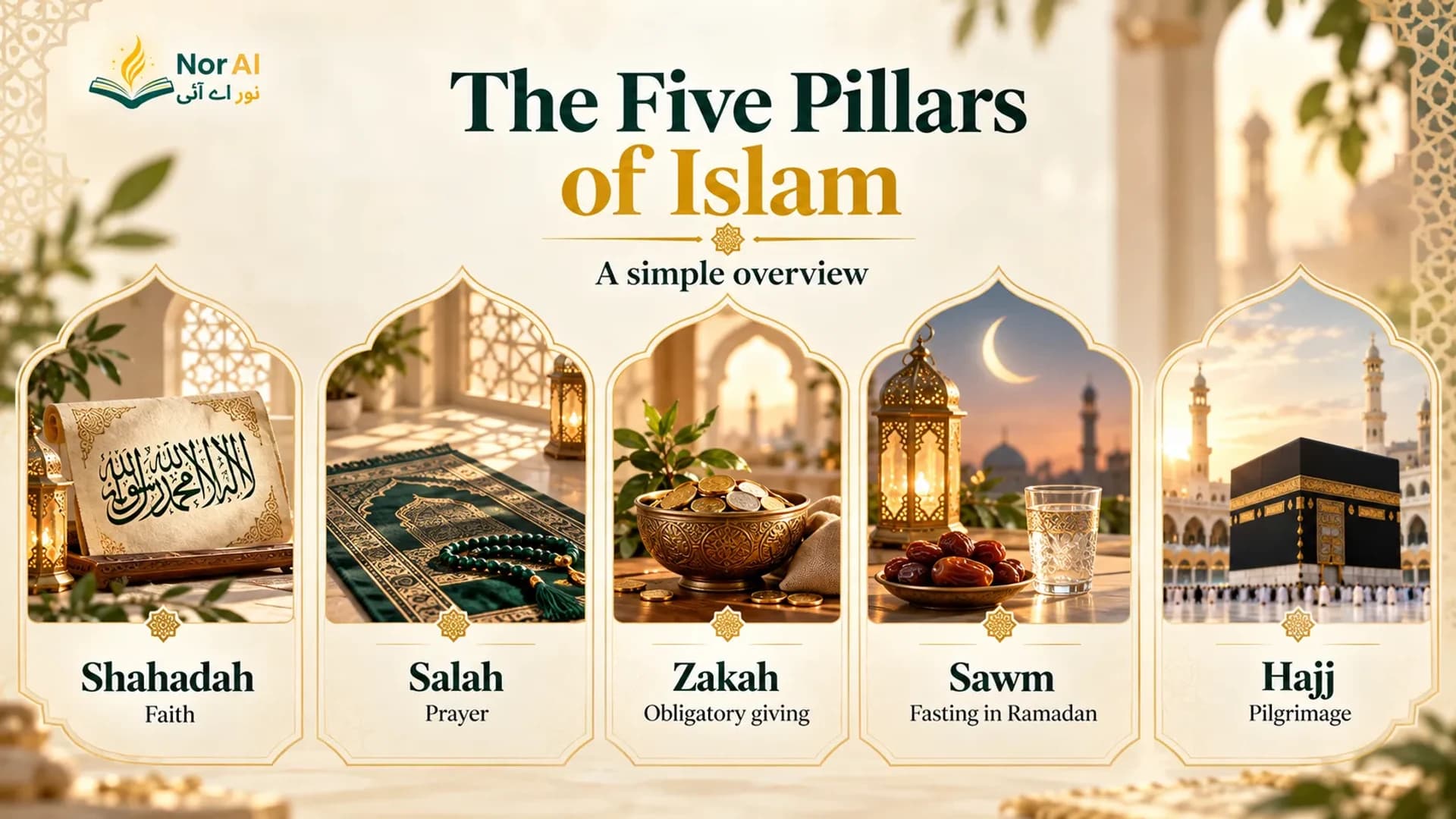
Quick Summary: The Five Pillars of Islam are Shahadah (declaration of faith), Salah (five daily prayers), Zakah (obligatory giving), Sawm (fasting during Ramadan) and Hajj (pilgrimage to Makkah). These five acts form the foundation of Islamic worship. Each has its own meaning, purpose and conditions, with some practised daily and others applying at specific times or when certain requirements are met.
This guide is for adults, beginners, new Muslims and families who want to understand the Five Pillars of Islam and how they are practised. It can be used as an introduction to Islamic beliefs and practices, a reference when learning the basics of Islam, or a starting point for explaining these pillars to family members. NorAI is a Quran and Islamic learning app that helps individuals and families learn about Islam through structured learning content, including Quran learning and everyday Islamic practices.
The Five Pillars of Islam are the central acts of worship that shape a Muslim’s life. They begin with a declaration of faith and include prayer, obligatory giving, fasting in Ramadan and pilgrimage to Makkah. Each has its own place in daily or lifelong practice.
For someone learning Islam, knowing the names is a start. Understanding when each pillar applies, and what it asks of a person, makes the list more useful.
What Are the Five Pillars of Islam?
The Five Pillars of Islam are Shahadah, Salah, Zakah, Sawm and Hajj. The Prophet Muhammad ﷺ named them together in a hadith on the Five Pillars of Islam. They are acts of worship rather than a complete list of everything Muslims believe or do.
| Pillar | Meaning | When it applies |
|---|---|---|
| Shahadah | Declaration of faith | Expressed throughout life |
| Salah | Prescribed prayer | Five times each day |
| Zakah | Obligatory giving | When its conditions are met |
| Sawm | Fasting during Ramadan | For those required and able to fast |
| Hajj | Pilgrimage to Makkah | Once in a lifetime for those able to undertake it |
1. What is Shahadah?
Shahadah is the declaration that there is no deity worthy of worship except Allah and that Muhammad ﷺ is His messenger. The first part affirms worship of Allah alone; the second affirms the message brought by the Prophet Muhammad ﷺ.
A person entering Islam says the declaration sincerely, with belief in its meaning. Understanding it matters more than simply repeating unfamiliar sounds. A beginner can first learn its meaning in a familiar language and then practise its Arabic pronunciation.
Shahadah gives context to the other pillars. A Muslim prays, gives, fasts and undertakes pilgrimage as acts of worship directed to Allah.
2. What is Salah?
Salah is the prescribed prayer performed five times each day. The prayers follow the course of the day, although their exact times vary by location, date and the method used to calculate them:
- Fajr: begins at dawn, before sunrise.
- Dhuhr: begins after the sun passes its highest point.
- Asr: takes place in the afternoon.
- Maghrib: begins after sunset.
- Isha: begins after twilight has ended.
Before prayer, a Muslim prepares through the required purification, such as wudu. Salah includes prescribed movements and Quran recitation while facing the qibla. The adhan announces prayer time; it is not an action that follows the prayer.
A new learner can begin with the five prayer names and the recitation used regularly, including Surah Al-Fatihah. Use a dependable local timetable for prayer times and learn correct recitation and Tajweed with a qualified teacher.
3. What is Zakah?
Zakah is an obligatory payment from qualifying wealth to eligible recipients. Its rules determine which assets count, the threshold for payment, when it becomes due and who may receive it. The Quran identifies categories of recipients in Surah At-Tawbah 9:60.
A rate of 2.5% commonly applies to qualifying wealth that meets the relevant conditions. This does not mean that every house, possession or form of property is automatically charged at 2.5%. A person’s savings, gold, business assets and other circumstances need to be assessed correctly.
Zakah differs from Sadaqah, which is voluntary giving. If you are unsure whether Zakah is due or how much to pay, seek guidance for your particular situation rather than relying on a general example.
4. What is Sawm?
Sawm means fasting. As a pillar of Islam, it refers to fasting during Ramadan. Muslims who are required and able to fast abstain from food and drink from dawn until sunset. The fast also invites care in speech, behaviour and worship.
A fasting day may start with suhoor before dawn and end with iftar at sunset. Daylight hours vary across locations and seasons, so the length of a fast is not the same everywhere. Ramadan is also a time when many Muslims make more room for prayer and Quran reading. The Quran discusses the prescription of fasting in Surah Al-Baqarah 2:183 and Ramadan in 2:185.
Allowances and rules for missed fasts depend on the circumstances. Illness, travel, pregnancy, breastfeeding and other health situations should be considered individually. Seek appropriate religious guidance and medical advice where health is involved.
Ramadan ends with Eid al-Fitr. Zakat al-Fitr is a separate obligation associated with the end of the month; it should not be confused with the annual Zakah discussed above.
5. What is Hajj?
Hajj is the pilgrimage to Makkah during Dhul Hijjah, the final month of the Islamic calendar. It is required once in a lifetime for Muslims who meet the conditions of ability. The Quran states the condition of being able to make the journey in Surah Ali Imran 3:97.
Pilgrims enter ihram and perform rites that include tawaf around the Kaaba, sa‘i between Safa and Marwah, and standing at Arafat. These rites follow a prescribed sequence, so someone preparing to travel needs detailed instruction and practical planning.
Hajj brings Muslims together in worship, but its obligation is tied to individual ability. For a beginner, understanding that condition is as important as remembering the name of the pillar.
What the Five Pillars Mean in Practice
The Five Pillars of Islam give Muslims a foundation for worship across daily life and a lifetime. Shahadah expresses faith in Allah, Salah brings prayer into each day, Zakah concerns qualifying wealth, Sawm shapes Ramadan, and Hajj is a pilgrimage for those able to undertake it.
If you are learning them for the first time, begin with what each pillar means. Then learn its practice and conditions step by step, seeking qualified guidance where your circumstances call for it.
Frequently Asked Questions about the Five Pillars of Islam
What are the Five Pillars of Islam in order?
The Five Pillars are Shahadah, Salah, Zakah, Sawm during Ramadan and Hajj. Together, they describe Islam’s central acts of worship.
Do Muslims practise all five pillars every day?
No. Salah is performed daily. Fasting takes place during Ramadan, Zakah is due when its conditions are met, and Hajj is a once-in-a-lifetime duty for those able to undertake it. Shahadah expresses the faith underlying them all.
Is Zakat the same as giving any donation?
No. Zakah is obligatory when its conditions are met and follows specific rules. A voluntary donation is a separate form of giving.
Can I learn the Five Pillars without knowing Arabic?
Yes. Begin with the meaning of each pillar in a language you understand. You can learn the Arabic terms and prayer recitation gradually, with help on pronunciation.
Are the Five Pillars the whole of Islam?
The Five Pillars are central acts of worship. Learning about Islam also includes belief, the Quran, the Prophet’s ﷺ teachings, character and responsibilities towards other people.
Download NorAI: Google Play Store · Apple App Store