
What Does It Mean to Understand the Quran?
For many Muslims, reading and reciting the Quran is already an important part of daily life. The words are familiar, the rhythm is meaningful, and certain verses may have been memorised for years. But a common question remains: what does it actually mean to understand the Quran?
Understanding the Quran begins with moving beyond recognising the Arabic text and gradually becoming familiar with the words, meanings, and relationships that appear within it. This does not mean that every learner must immediately study advanced Arabic grammar, tafseer, or detailed scholarly interpretation. For a beginner, understanding can start much more simply: recognising a Quranic word and knowing what that word means.
Understanding Starts With Quranic Words
Every verse of the Quran is made up of words. When those words are unfamiliar, a learner may be able to recite them correctly without knowing what they communicate.
This is why Quranic vocabulary can provide an important starting point. Learning common Quranic nouns, verbs, pronouns, and connecting words gradually makes the Arabic text more familiar. Instead of seeing an entire ayah as one continuous line of Arabic, the learner can begin identifying words they have already studied.
Over time, the experience changes from simply recognising a verse to recognising some of the words within it and understanding their meanings. That is an important step towards Quran understanding.
NorAI follows this word-focused approach through a structured 20-level Quranic Arabic curriculum. The journey begins with Qaida and reading foundations, then gradually introduces scholar-reviewed Quranic nouns, pronouns, particles, verbs, approved word relationships, and controlled Quranic context.
Understanding Is Different From Memorisation
Memorisation and understanding can support each other, but they are not the same thing. A person may memorise a surah accurately without understanding every Arabic word within it. Likewise, someone may recognise the meaning of several Quranic words without having memorised the entire verse.
Understanding focuses on developing familiarity with what the words mean. When a learner repeatedly encounters a Quranic word and remembers its meaning across different lessons and contexts, the word becomes increasingly familiar. The learner no longer depends entirely on a translation to recognise it.
NorAI separates lesson progress from word mastery. Completing a lesson shows progress, while remembering a word across different sessions shows that recognition has become more stable over time.
Why Word-by-Word Understanding Matters
Trying to understand an entire Quranic verse at once can feel difficult for someone who is new to Arabic. A word-by-word approach makes the process more manageable.
Instead of beginning with complex explanations, learners can first develop familiarity with individual words. Once enough vocabulary has been recognised, those words can gradually be seen inside phrases and Quranic passages.
A structured journey can therefore move from letters and sounds to Quranic words, word meanings, pronouns and connectors, verbs, short phrases, and finally controlled Quranic context. This progression helps prevent beginners from being overwhelmed with too much Arabic terminology at once.
Hearing the Word Can Strengthen Recognition
Quranic Arabic is not only something learners see on a screen or page. It is also something they hear during recitation. For this reason, listening can support understanding.
When a learner sees a Quranic word while also hearing its recitation, they can begin connecting the Arabic form, the sound, and the scholar-reviewed meaning. Repeated exposure makes the word easier to recognise when it appears again.
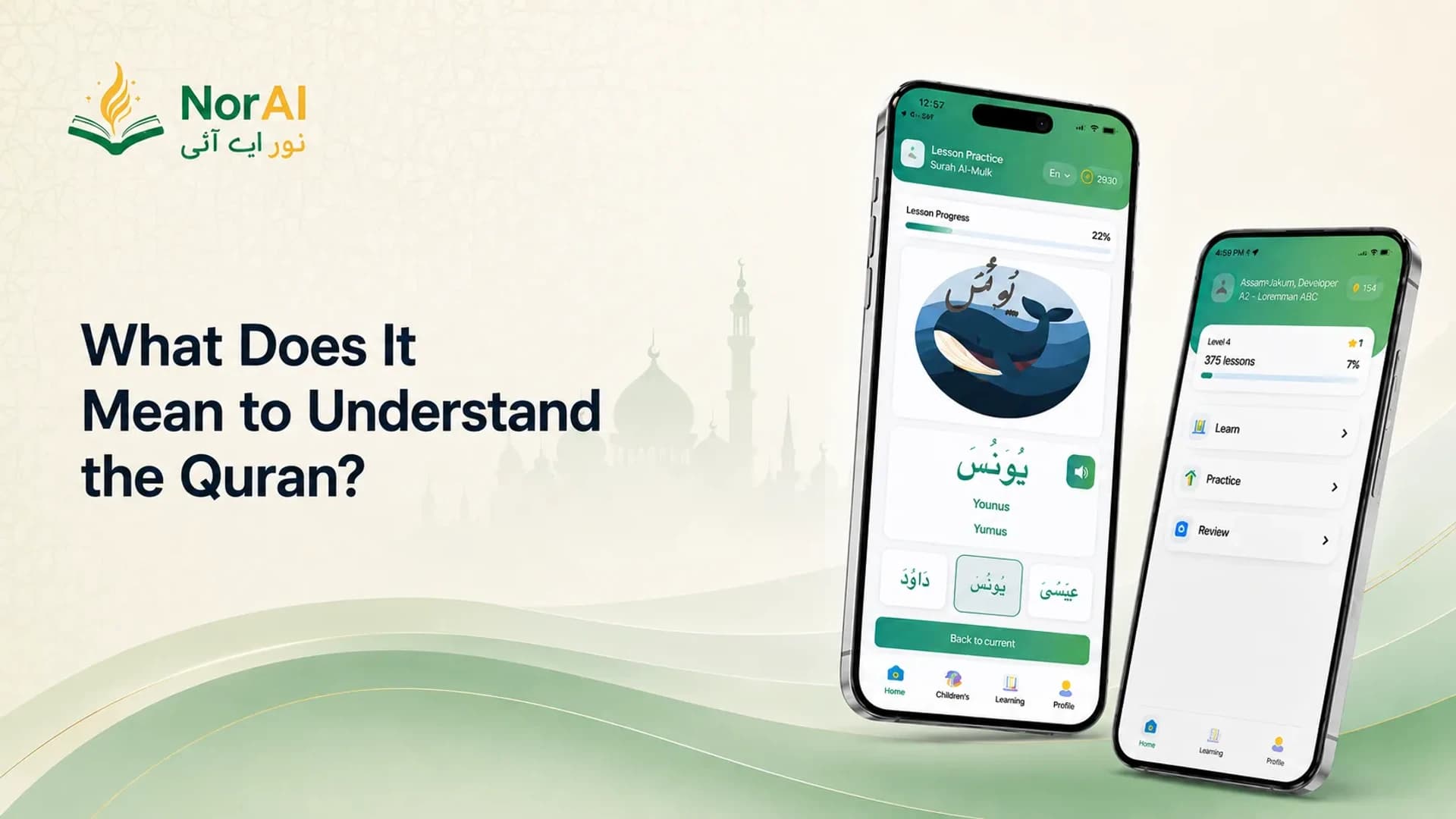
NorAI reinforces Quranic vocabulary through six practice types: Visual Learning, Articulation Practice, Audio Practice, Writing Practice, Match Quiz, and Word Joining. Each activity supports recognition and retention in a different way, while Word Joining begins from Level 16 with known components and approved forms.
Visual Learning Can Help Connect Words With Meaning
Some Quranic words describe things, people, places, actions, or concepts that can be supported visually. For suitable vocabulary, a clear visual can help create a stronger memory connection between the Arabic word and its meaning.
Visual support is not intended to replace the Quranic text or explain religious interpretation. It simply supports vocabulary recognition where an image can clarify the basic, scholar-reviewed meaning.
Practice Turns Recognition Into Familiarity
Seeing a word once does not usually mean that it has been learned. Real familiarity develops through repeated encounters.
A learner might first see a word, hear it, recognise it through Match Quiz, practise it through Writing Practice, and meet it again during review. From Level 16, Word Joining helps learners work with known components in approved forms. Repeated encounters support stronger recognition and retention over time.
Understanding Does Not Mean Giving Tafseer
It is important to distinguish Quranic vocabulary learning from tafseer. Knowing the basic scholar-reviewed meaning of a Quranic word can help a learner understand the language of the Quran, but deeper interpretation belongs to qualified scholarship.
NorAI focuses on Quranic Arabic vocabulary and scholar-reviewed word meanings. It does not provide tafseer, fatwa, theological rulings, or AI-generated Quranic meanings or interpretations. Quranic learning content is authored and reviewed through a controlled scholarly approval process before publication.
Understanding Develops Gradually
There is no single moment when someone suddenly understands the Quran. It develops step by step. At first, a learner may recognise only a few familiar Arabic words. Later, pronouns and connectors become easier to notice, verbs become easier to identify, and previously learned words begin to appear inside phrases and Quranic verses.
The important thing is consistency. A learner does not need to understand every word immediately. Each recognised word adds another piece to their understanding.
How NorAI Supports Quran Understanding
NorAI is designed to help learners build Quranic Arabic understanding from the word level upward. The platform uses a structured 20-level learning path with scholar-reviewed content, guided practice, repeated review, and gradual progression into approved word relationships and Quranic context.
Learners work with Quranic vocabulary through Visual Learning, Articulation Practice, Audio Practice, Writing Practice, Match Quiz, Word Joining, and repeated review. The aim is not to replace parents, teachers, or qualified scholars, but to help learners become increasingly familiar with Quranic Arabic words and scholar-reviewed meanings as they read and listen to the Quran.
Building Quran Understanding One Word at a Time
So, what does it mean to understand the Quran? For a learner beginning with Quranic Arabic, it can mean recognising more of the words that appear in the Quran, knowing their scholar-reviewed meanings, remembering them over time, and gradually noticing how familiar words appear within Quranic phrases and verses.
Understanding does not have to begin with complex grammar or long explanations. It can begin with one word, then another, until the Arabic of the Quran becomes more familiar and meaningful over time.