
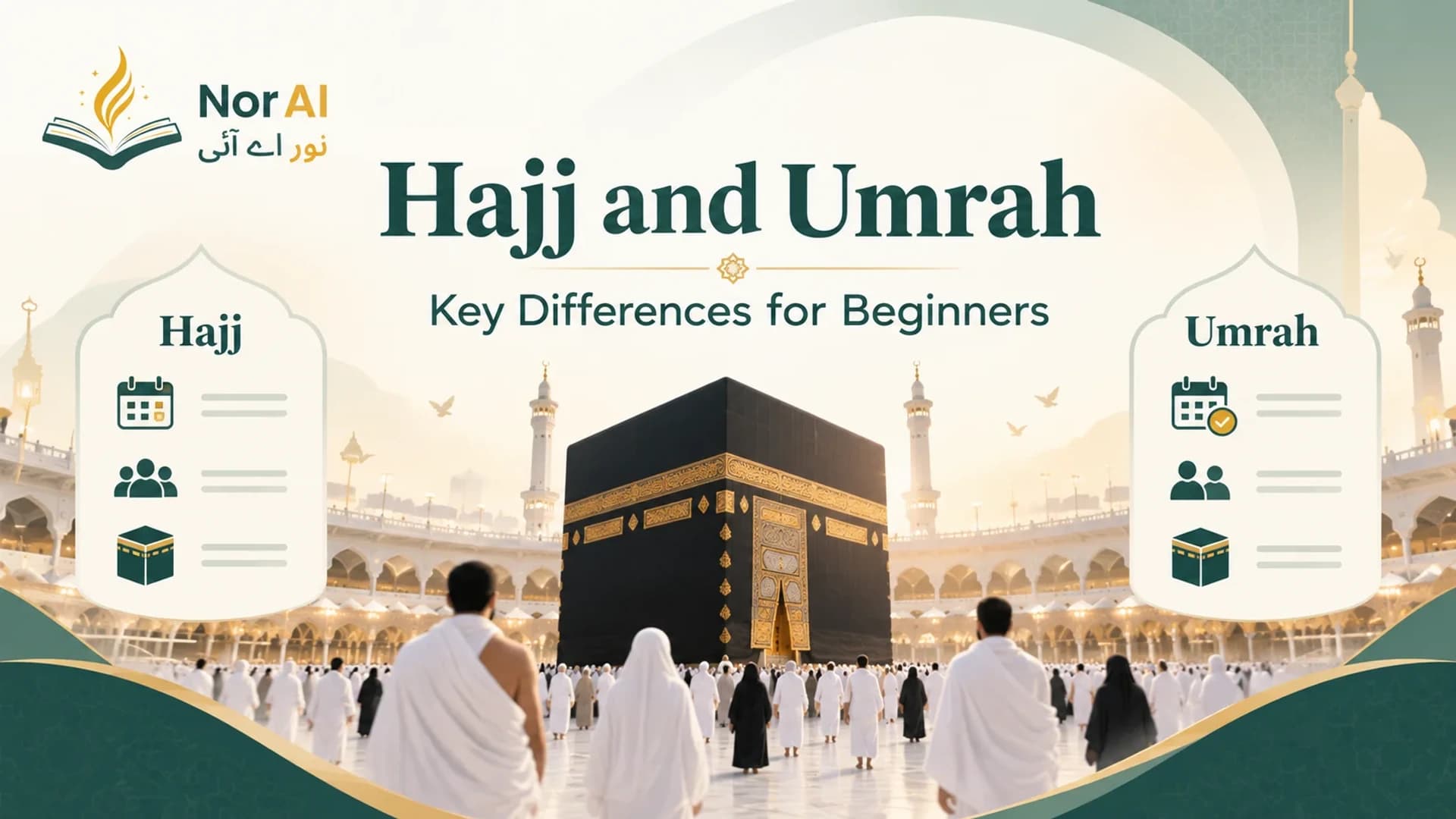
Hajj and Umrah: Key Differences for Beginners
Hajj and Umrah are two important forms of pilgrimage in Islam. Both involve travelling to Makkah, entering the state of Ihram and performing acts of worship connected to the Kaaba. However, they differ in their religious obligations, timing, duration and rituals.
For someone learning about Islamic pilgrimage for the first time, these differences can seem confusing. Why is Hajj performed on particular dates while Umrah can be performed at other times of the year? Is Umrah part of Hajj? And does completing Umrah mean that a Muslim has fulfilled the obligation of Hajj?
This guide explains the main differences between Hajj and Umrah, the stages involved in each pilgrimage and what beginners should understand before making plans.
Quick answer: The main difference between Hajj and Umrah is that Hajj is an obligatory pilgrimage once in a lifetime for Muslims who meet its conditions and must be performed during specified dates in Dhul Hijjah. Umrah is a shorter pilgrimage involving Ihram, Tawaf, Sa'i and completing the required hair-cutting rites. It can generally be performed throughout the year, subject to official arrangements.
Hajj vs Umrah: Key Differences at a Glance
| Feature | Hajj | Umrah |
|---|---|---|
| Meaning | The major Islamic pilgrimage | The lesser pilgrimage |
| Religious obligation | Obligatory once in a lifetime for Muslims who meet the required conditions | Its legal status differs between Islamic schools of thought |
| Timing | Performed during specified days of Dhul Hijjah | Generally performed throughout the year, subject to restrictions |
| Duration | Takes several days to complete its main rites | Usually completed within several hours, depending on circumstances |
| Location | Includes Makkah, Mina, Arafat and Muzdalifah | Main rites take place in Makkah |
| Shared rituals | Ihram, Tawaf and Sa'i, according to the form of Hajj | Ihram, Tawaf and Sa'i |
| Distinctive rituals | Standing at Arafat, Muzdalifah, Mina and stoning the Jamarat | Does not include these Hajj-specific rites |
| Completion | Depends on completing the required Hajj rites | Completed through the prescribed Umrah rites |
Both pilgrimages are important acts of worship, but they are not interchangeable. Performing Umrah does not fulfil the separate obligation of Hajj.
What Is Hajj in Islam?
Hajj is the major pilgrimage to Makkah and one of the Five Pillars of Islam.
It is obligatory once in a lifetime for Muslims who meet the necessary religious conditions, including the ability to undertake the pilgrimage. Hajj takes place during specified dates in the Islamic month of Dhul Hijjah.
The Quran states in Surah Ali Imran, 3:97, that pilgrimage to the House is an obligation for those who are able to undertake it.
Source: Quran 3:97.
Hajj involves a series of acts of worship performed at different locations in and around Makkah. Among its most important rites is standing at Arafat on the ninth day of Dhul Hijjah.
Other rites include staying at Muzdalifah, spending time in Mina, stoning the Jamarat, Tawaf and Sa'i, according to the requirements of the pilgrim's particular form of Hajj.
The pilgrimage requires preparation, knowledge of its sequence and adherence to the relevant religious and official travel requirements.
What Are the Main Stages of Hajj?
The main Hajj journey generally involves the following stages:
- Entering Ihram: The pilgrim enters the prescribed state of consecration with the intention of performing Hajj.
- Mina: Pilgrims proceed to Mina, commonly on the eighth day of Dhul Hijjah.
- Arafat: On the ninth day, pilgrims gather at Arafat for one of the central rites of Hajj.
- Muzdalifah: After leaving Arafat, pilgrims travel to Muzdalifah.
- Jamarat: Pilgrims perform the prescribed stoning rites during the relevant days.
- Tawaf and Sa'i: These rites are performed as required by the particular form of Hajj.
- Completion of remaining rites: Pilgrims complete the remaining prescribed acts before their Hajj concludes.
This is a simplified learning sequence. The exact order and requirements can vary depending on the type of Hajj and individual circumstances.
For practical details, Saudi Arabia's official Nusuk Hajj guide explains the main journey and its stages.
What Is Umrah in Islam?
Umrah is a pilgrimage to Makkah involving a shorter set of prescribed rituals.
It shares several acts of worship with Hajj, including entering Ihram and performing Tawaf around the Kaaba and Sa'i between Safa and Marwa.
Unlike Hajj, Umrah does not require pilgrims to attend Arafat, stay at Muzdalifah or perform the stoning rites at the Jamarat.
Umrah is generally available throughout the year, subject to Saudi regulations, seasonal arrangements and temporary restrictions, particularly around the Hajj period.
Islamic scholars differ on whether Umrah is obligatory once in a lifetime or a strongly recommended act of worship. Beginners should therefore avoid treating its legal status as identical across all schools of Islamic jurisprudence.
What Are the Main Steps of Umrah?
The Umrah journey includes four main stages:
- Ihram: Entering the state of Ihram with the intention of performing Umrah.
- Tawaf: Circling the Kaaba seven times.
- Sa'i: Walking seven lengths between Safa and Marwa, beginning at Safa and ending at Marwa.
- Hair cutting: Completing the required shaving or shortening of hair according to the relevant rules.
After completing the prescribed rites, the pilgrim exits Ihram.
These stages are explained in Saudi Arabia's official Nusuk Umrah guide.
Although the basic sequence is shorter than Hajj, pilgrims should still learn the relevant conditions and requirements before beginning.
1. Hajj and Umrah Differ in Religious Obligation
One of the most important differences concerns whether each pilgrimage is compulsory.
Is Hajj Obligatory?
Hajj is obligatory once in a lifetime for Muslims who satisfy its conditions, including the ability to perform it.
The obligation is established in the Quran and is recognised across the major schools of Islamic jurisprudence.
However, being able to undertake Hajj involves more than simply wishing to travel. Religious, financial, physical and other applicable conditions need to be considered.
Is Umrah Obligatory?
The legal ruling on Umrah differs among Islamic schools of thought.
In the Hanafi and Maliki traditions, Umrah is generally regarded as a highly recommended Sunnah rather than an individual obligation. In the Shafi'i and Hanbali traditions, Umrah is generally considered obligatory once in a lifetime for those who meet its conditions.
The Quran mentions both pilgrimages in Surah Al-Baqarah:
وَأَتِمُّوا الْحَجَّ وَالْعُمْرَةَ لِلَّهِ
A short English rendering is:
"Complete the Hajj and Umrah for Allah."
Source: Quran 2:196.
This verse is important in discussions of pilgrimage, although the schools of jurisprudence differ in how they interpret the legal obligation of Umrah.
For personal religious questions about whether Umrah is required in a particular situation, consult a qualified scholar familiar with the relevant school of Islamic jurisprudence.
2. Hajj Has Fixed Dates, While Umrah Is More Flexible
Hajj takes place during specified dates in Dhul Hijjah, the twelfth month of the Islamic calendar.
The main rites are performed over several days, with the eighth, ninth and tenth days forming central parts of the pilgrimage and additional rites continuing afterwards.
This fixed schedule is an important reason Hajj requires more advance planning.
Umrah, by comparison, can generally be performed during different periods of the year.
However, this flexibility does not mean that every date is available to every traveller. Visa conditions, official permits and restrictions around the Hajj season can affect when Umrah may be performed.
For this reason, anyone planning to travel should check current requirements through Saudi Arabia's official pilgrimage services before making arrangements.
3. Hajj Includes Rituals That Are Not Part of Umrah
Both Hajj and Umrah include acts of worship connected to the Kaaba, but Hajj involves additional rites at specific locations.
What Is Tawaf?
Tawaf involves circling the Kaaba seven times as part of the prescribed pilgrimage rites.
It is performed during Umrah and at different stages of Hajj, depending on the type of pilgrimage and the particular rite.
What Is Sa'i?
Sa'i involves travelling seven lengths between Safa and Marwa.
The Quran refers to Safa and Marwa as among the symbols of Allah in Surah Al-Baqarah, 2:158.
Sa'i is part of Umrah and is also performed during Hajj according to its requirements.
What Makes Hajj Different?
Hajj includes several additional rites, particularly the standing at Arafat.
Pilgrims also perform prescribed acts involving Mina, Muzdalifah and the Jamarat. These rites are not part of an independent Umrah pilgrimage.
Understanding the places and their purpose helps beginners avoid confusing the two journeys.
4. Hajj Usually Takes Longer Than Umrah
Another practical difference is the time required to complete the pilgrimages.
The main Hajj rites take place over several days and follow a particular calendar-based sequence.
Umrah's prescribed rites are shorter and may be completed within several hours, depending on crowd conditions, physical ability and other circumstances.
However, the total duration of an Umrah trip may be much longer because of travel, accommodation and personal arrangements.
Similarly, Hajj packages often include days before and after the main pilgrimage rites.
The important distinction is between the time required for the rituals and the total length of the trip.
5. Hajj and Umrah Have Different Planning Requirements
Both pilgrimages require appropriate preparation, but the arrangements can differ significantly.
Hajj takes place during a limited annual period and involves movement between several ritual locations. Pilgrims must account for the official Hajj programme, eligibility requirements, transport arrangements and the demands of completing multiple rites.
Umrah usually offers more flexibility in travel dates, although official restrictions and permit requirements still apply.
What Should Beginners Prepare Before Travelling?
| Preparation | Hajj | Umrah |
|---|---|---|
| Learn the rituals | Understand the complete Hajj sequence | Understand the main Umrah steps |
| Check travel documents | Confirm Hajj-specific entry and permit requirements | Confirm current Umrah entry and permit requirements |
| Understand Ihram | Learn the applicable conditions and restrictions | Learn the applicable conditions and restrictions |
| Prepare physically | Account for several days of demanding activities | Prepare for Tawaf, Sa'i and walking |
| Plan transport | Allow for movement between different Hajj locations | Plan access to Makkah and the Grand Mosque |
| Seek religious guidance | Clarify questions about your selected Hajj type | Clarify questions about Umrah requirements |
This preparation list is educational rather than a substitute for official travel instructions or individual religious guidance.
6. Can Umrah Be Performed During Hajj?
Yes. Umrah may be connected with Hajj, depending on the type of Hajj being performed.
The three recognised forms of Hajj are Tamattu', Qiran and Ifrad.
Hajj Tamattu': The pilgrim performs Umrah, exits Ihram and later enters Ihram again for Hajj.
Hajj Qiran: The pilgrim combines Hajj and Umrah in one Ihram.
Hajj Ifrad: The pilgrim enters Ihram for Hajj alone.
Each form has particular requirements, including differences in sacrificial obligations and the sequence of rituals.
Saudi Arabia's official Nusuk Hajj rituals guide provides an overview of these forms.
Beginners should learn which form applies to their intended pilgrimage before travelling.
7. Does Performing Umrah Replace Hajj?
No. Performing Umrah does not replace the obligation of Hajj.
A Muslim who has completed Umrah has performed the prescribed acts of that pilgrimage, but this does not mean the separate obligation of Hajj has been fulfilled.
If Hajj becomes obligatory for that person because the relevant conditions are met, the obligation remains unless Hajj itself is performed.
This distinction is particularly important for beginners who may hear Umrah described as a smaller pilgrimage and assume that it counts as a substitute.
Umrah and Hajj are connected forms of worship, but each has its own rulings and prescribed rites.
8. How Can Beginners Learn the Difference Between Hajj and Umrah?
Understanding pilgrimage is often easier when the places, stages and terminology are introduced separately.
Rather than trying to memorise every ritual immediately, beginners can begin with the main distinctions.
Start by understanding what each pilgrimage involves, when it takes place and which rituals are shared.
Next, learn the sequence of the main rites. For Hajj, pay particular attention to Arafat, Muzdalifah and Mina. For Umrah, focus on Ihram, Tawaf, Sa'i and hair cutting.
It can also help to review the terminology before studying more detailed rulings.
NorAI's Islamic Learning resources introduce pilgrimage alongside other subjects such as Salah, purification and Islamic beliefs. The website also includes separate learning pages for Hajj and Umrah.
For related learning, beginners can review Wudu and Ghusl to become familiar with purification terminology, while recognising that the rules of Ihram and pilgrimage have their own requirements.
Educational guides can help with preparation, but the details of actual worship should be confirmed through qualified religious guidance and current official pilgrimage instructions.
Common Mistakes Beginners Should Avoid
Several misunderstandings can arise when Hajj and Umrah are discussed together.
Assuming Umrah replaces Hajj: The two pilgrimages have distinct religious rulings. Completing Umrah does not fulfil Hajj.
Thinking Hajj can be performed at any time: Hajj has fixed dates, unlike the more flexible general timing of Umrah.
Confusing the main rituals: Standing at Arafat, the rites at Muzdalifah and the stoning rituals belong to Hajj, not an independent Umrah.
Assuming every form of Hajj follows exactly the same sequence: Tamattu', Qiran and Ifrad involve differences that should be understood before travelling.
Treating travel arrangements as religious requirements: Package duration, hotel choices and travel routes should not be confused with the prescribed acts of worship.
Following outdated travel information: Official entry, permit and health requirements may change. Always confirm the current rules before booking or travelling.
Frequently Asked Questions
What is the main difference between Hajj and Umrah?
Hajj is the major Islamic pilgrimage performed during specified dates in Dhul Hijjah and is obligatory once in a lifetime for eligible Muslims. Umrah is a shorter pilgrimage that can generally be performed throughout the year and involves fewer rituals.
Is Hajj more important than Umrah?
Hajj has a distinct religious status as one of the Five Pillars of Islam and an established obligation for those who meet its conditions. Umrah is also an important act of worship, but its legal status differs among Islamic schools of thought.
Can Umrah be performed at any time of the year?
Umrah is generally possible throughout the year. However, official restrictions, especially during the Hajj season, may affect availability. Travellers should check current Saudi requirements.
Can someone perform Umrah without performing Hajj?
Yes. Umrah can be performed independently of Hajj. Completing Umrah does not remove a person's separate Hajj obligation if the conditions for Hajj are met.
Do Hajj and Umrah involve the same rituals?
They share several rituals, including Ihram, Tawaf and Sa'i, but Hajj includes additional acts of worship at Arafat, Muzdalifah, Mina and the Jamarat.
How long does Umrah take compared with Hajj?
The main Umrah rituals may be completed within several hours, depending on circumstances. Hajj involves a prescribed sequence of rites over several days. The total duration of either trip may be longer.
Is it necessary to perform Umrah before Hajj?
No. Performing an independent Umrah before Hajj is not a universal requirement. Some forms of Hajj include Umrah, while Hajj Ifrad involves Hajj alone.
What should a beginner learn before performing Hajj or Umrah?
Beginners should understand Ihram, the sequence of rituals, the significance of each location, the main prohibitions and the completion requirements. They should also confirm current official travel arrangements and seek qualified guidance about religious rulings.
Understanding Hajj and Umrah Before Your Journey
Hajj and Umrah share important acts of worship, but their timing, requirements and rituals are different.
Hajj is performed during a fixed period of Dhul Hijjah and includes rites at several locations around Makkah. Umrah follows a shorter sequence centred on the Kaaba and Safa and Marwa.
For beginners, learning these differences provides a useful foundation before studying the detailed steps of either pilgrimage.
Taking time to understand the sequence, terminology and religious responsibilities can help learners approach Hajj and Umrah with greater clarity and respect.
Learn Quran & Islam with NorAI
Continue your learning journey with NorAI through structured lessons, interactive practice and scholar-reviewed content for adults and families.
NorAI is free to start. Download the app: