
How Audio Supports Quranic Arabic Vocabulary Learning
Learning Quranic Arabic vocabulary involves more than reading Arabic words alongside their English meanings.
A learner may recognise a word while looking at it but struggle to identify the same word when hearing Quran recitation. Someone else may remember how a word sounds but remain unsure about its written form or meaning.
Audio helps connect these different parts of vocabulary learning.
By hearing a Quranic Arabic word while viewing its written form and meaning, learners can build a stronger relationship between sound, appearance, and understanding. Over time, this can make familiar words easier to notice while reading or listening to the Quran.
Why Audio Matters in Quranic Arabic Learning
The Quran is both read and heard, so Quranic vocabulary learning should not remain limited to silent reading exercises. Learners also need opportunities to become familiar with how individual words sound.
For example, when a learner studies the wordرَحْمَة, meaning mercy, reading the word and its meaning provides one form of learning, while hearing it adds another important layer.
The learner gradually begins connecting the Arabic word with its pronunciation, written form, and meaning. These connections can make the vocabulary easier to remember and recognise in future lessons.
Audio does not replace reading, visual learning, or revision. Instead, it works alongside them to create a more complete learning experience.
Connecting Sound With Meaning
One of the main benefits of audio-supported vocabulary learning is that it connects spoken Arabic directly with meaning.
Without audio, a learner may remember the appearance of a word but remain uncertain when hearing it. With regular listening practice, the sound itself can begin to remind the learner of the meaning.
For example, when learners hear a Quranic word and select its correct meaning, they are not simply repeating a recording. They are actively recalling vocabulary from sound.
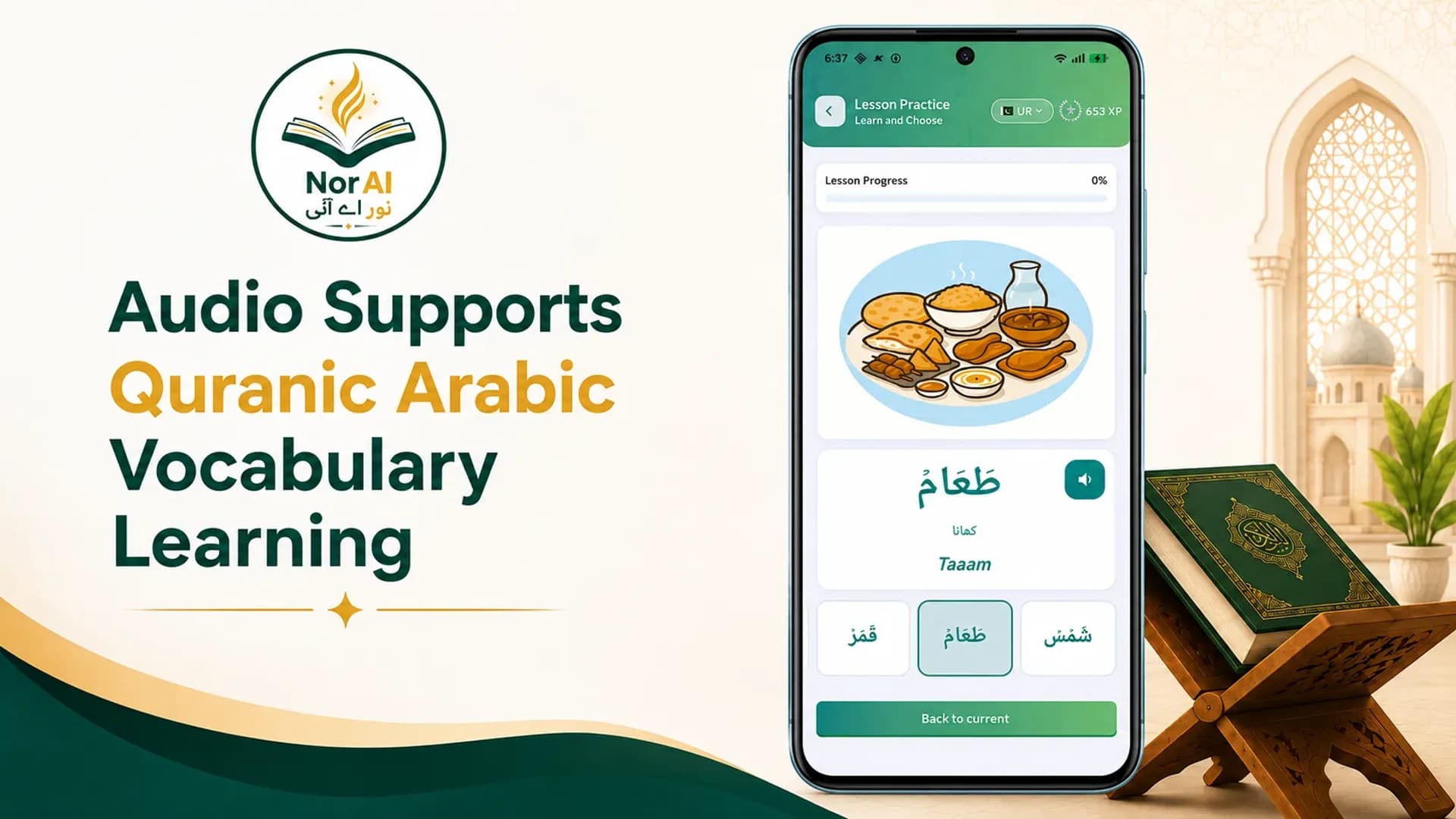
NorAI includes a Listen and Select practice method in which the learner hears a Quranic word and chooses its meaning. This activity is designed to connect recitation audio with vocabulary understanding.
Helping Learners Recognise Words During Recitation
Many learners begin studying Quranic Arabic because they want to understand more of what they read and hear.
A person may already listen to Quran recitation regularly, but individual words can pass unnoticed when their meanings are unfamiliar. As vocabulary grows, certain words may gradually begin to stand out.
A learner who has studied a word through writing, visuals, meaning, and audio may recognise it when it appears during recitation.
That moment can be encouraging.
Instead of hearing only an unfamiliar flow of Arabic, the learner starts noticing individual words and recalling their meanings. This recognition does not happen immediately, but repeated audio-supported practice can help it develop naturally.
Supporting Different Ways of Learning
Not every learner remembers vocabulary in the same way. Some learners remember what they see, while others remember what they hear. Many learn more effectively when visual, written, and audio methods are combined.
| Learner’s Need | How Audio Supports Learning |
|---|---|
| Finds text-only vocabulary lists difficult to remember | Audio adds sound to the learning process, making words easier to recognise and recall. |
| Regularly listens to Quran recitation | Hearing studied words can help learners notice familiar vocabulary during recitation. |
| Benefits from repetition | Learners can hear the same word more than once to strengthen familiarity and memory. |
| Is unfamiliar with certain Arabic sounds | Clear audio helps learners become more aware of how Quranic Arabic words sound. |
| Prefers short listening-based activities | Audio can be used in simple and focused practice sessions without relying only on written exercises. |
| Wants to connect spoken words with their meanings | Listening activities help learners associate the sound of a word with its correct meaning. |
| Needs easier-to-follow lessons | For younger learners, audio reduces dependence on written explanations and makes lessons more accessible. |
NorAI combines recitation audio with visuals, articulation guidance, writing guidance, and structured vocabulary practice. This allows learners to experience each Quranic word in more than one way.
Strengthening Memory Through Repetition
Hearing a new word once is rarely enough to remember it.
Vocabulary becomes more familiar when learners meet the same word several times across different activities and learning sessions.
A Quranic word may first appear with:
- A supporting image
- Its written Arabic form
- Its meaning
- Recitation audio
The learner may later hear the word in a listening exercise, match it with its meaning, or identify it inside a Quranic verse.
Each encounter strengthens the learner’s familiarity with the word.
The purpose is not to repeat a word continuously in one session. Instead, the word should return over time, allowing the learner to practise recalling it after short and longer gaps.
NorAI uses structured review to support this process. Words that require more practice can appear more often, while familiar words can return after longer intervals.
This helps learners work towards long-term vocabulary recognition rather than temporary memorisation.
Audio and Visual Learning Work Better Together
Audio becomes more effective when learners can connect a word’s sound with a clear and understandable meaning.
A suitable visual first helps explain the concept, the written Arabic word introduces its original form, and recitation audio helps learners recognise how it sounds.
Together, this creates a natural learning connection in which the learner:
- Sees the image
- Understands the meaning
- Recognises the Arabic word
- Becomes familiar with its sound
For example, when learning a word related to light, a path, water, a book, or mercy, viewing a relevant image while hearing the word can make it easier to understand, remember, and recognise later.
NorAI combines visual explanations with recitation audio to support Quranic word recognition and understanding.
The visuals are used only as learning aids and do not replace, alter, or simplify the original Quranic text.
Building Awareness of Arabic Sounds
Quranic Arabic includes sounds that may be unfamiliar to non-Arabic speakers.
Some letters may initially sound similar, while others require learners to pay closer attention to how each word is formed.
Listening to clear word audio can help learners notice:
- The sounds within a word
- The effect of short vowel marks
- The order of Arabic letters
- Where each sound begins and ends
- How the complete word is pronounced
NorAI also provides visual articulation guidance to help learners understand how Arabic letters and sounds are formed during vocabulary practice.
However, NorAI does not offer formal Tajweed instruction. Its audio and articulation features are designed to support Quranic Arabic vocabulary recognition, pronunciation awareness, and understanding rather than replace learning recitation from a qualified teacher.
Making Listening an Active Exercise
Audio is most effective when the learner responds to what they hear.
Listening passively can provide exposure, but active listening requires the learner to think, remember, and choose.
A simple audio activity may involve:
- Listening carefully to a Quranic word
- Recalling its meaning
- Selecting the correct answer
- Listening again when the answer is incorrect
- Reviewing the word in another activity
This process helps the learner identify which words are familiar and which still require revision.
NorAI’s practice system includes four methods:
Tap to Recognise
The learner sees a Quranic word and selects its correct meaning.
Listen and Select
The learner hears the word and chooses its meaning.
Meaning Match
The learner matches Quranic Arabic words with their meanings.
Tap to Highlight
The learner identifies the studied word inside a Quranic verse.
Together, these activities connect audio with visual recognition, active recall, meaning, and Quranic context.
Supporting Flexible and Offline Learning
Audio-supported vocabulary practice does not always require a long study session.
A learner can spend a short period listening to a small group of words, reviewing their meanings, and testing recognition. Short and regular sessions may be easier to maintain than occasional long lessons.
NorAI allows supported lesson packs and audio to be downloaded for offline learning. Once the content has been downloaded, learners can continue practising without an active internet connection.
Progress may synchronise when the device reconnects.
This can support learning:
- At home
- While travelling
- In areas with limited internet access
- During short periods of free time
- As part of a regular family learning routine
A Simple Audio Vocabulary Routine
Learners do not need to study a large number of words at once.
A simple routine can begin with a small group of Quranic words:
- Look at the Arabic word.
- Listen to its recitation audio.
- Read or view its meaning.
- Listen again without looking at the meaning.
- Try to recall the meaning from the sound.
- Complete a listening or matching activity.
- Review the word again on another day.
- Identify it when it appears inside a Quranic verse.
This routine helps learners move from first exposure towards stronger recognition.
How NorAI Uses Audio for Quranic Vocabulary Learning
NorAI is designed to help adults, children, and families understand Quranic Arabic word by word.
Within the learning experience, audio is not treated as a separate feature. It works together with:
- Visual word explanations
- Quranic word meanings
- Articulation guidance
- Arabic writing guidance
- Listening activities
- Word-matching practice
- Recognition inside Quranic verses
- Structured review
- Progress and mastery tracking
Every Quranic word and meaning is reviewed through a scholar-led process before being provided to learners.
NorAI does not use artificial intelligence to generate Quranic meanings, translations, Tafseer, fatwas, or religious explanations.
The focus remains on building vocabulary recognition and helping learners understand more of the Quranic words they read and hear.
Final Thoughts
Audio plays an important role in Quranic Arabic vocabulary learning because it connects written words with spoken language.
When learners see a word, hear it, understand its meaning, practise recalling it, and meet it again inside a verse, the vocabulary becomes more familiar from several directions.
This process takes time. Learners may not recognise every word immediately, and some words will require more repetition than others.
With structured and consistent practice, however, sounds that once seemed unfamiliar can gradually become meaningful.
NorAI supports this learning journey through visuals, recitation audio, articulation guidance, writing practice, word-recognition activities, and structured review.
Start understanding Quranic Arabic word by word with NorAI.
Frequently Asked Questions
How does audio help with Quranic Arabic vocabulary learning?
Audio helps learners connect the sound of a Quranic word with its written form and meaning. This can make the word easier to recognise during lessons, revision, and Quran recitation.
Does NorAI include audio for Quranic words?
Yes. NorAI includes recitation audio to help learners hear Quranic words while studying their written forms and meanings. Audio is also used in listening-based vocabulary activities.
What is the Listen and Select activity in NorAI?
Listen and Select is a practice activity in which the learner hears a Quranic word and chooses its correct meaning. It helps connect listening with vocabulary recall.
Can beginners use audio to learn Quranic Arabic words?
Yes. Beginners can hear a word while seeing its Arabic form, meaning, and supporting visual. This helps them become familiar with the vocabulary without relying only on text.
Is it better to learn Quranic vocabulary through audio or visuals?
Both methods can support learning. Visuals help explain meaning, while audio helps learners recognise how the word sounds.
NorAI combines visuals, recitation audio, writing guidance, and practice rather than depending on one method alone.
Can NorAI audio be used offline?
Supported lesson packs and audio can be downloaded for offline practice. Progress may synchronise after the device reconnects to the internet.
Is NorAI suitable for adults, children, and families?
Yes. NorAI is designed for adult learners, young learners, and families.
Parent-managed profiles allow families to support minor learners while keeping billing and account controls separate from the learning experience.