
Never Learned the Quran? It's Not Too Late to Start
Maybe you never had the chance to learn the Quran when you were younger. Perhaps you remember a few Arabic letters but struggle to read them together. You may even know some short surahs by heart without being able to follow the written Arabic.
If you've been thinking about learning the Quran as an adult, one question might be holding you back: Is it too late to start?
The answer is no.
You can begin with Arabic letters, learn how they join together and gradually work towards reading familiar Quranic words. You don't need previous Arabic knowledge to begin, and you don't need to rush through lessons to make progress.
Quick answer: Adults can start learning Quranic Arabic from scratch by recognising Arabic letters and their sounds, practising how letters join together, learning to read simple words and reviewing what they've studied. As reading skills improve, learners can move towards suitable Quran passages and familiar word meanings.
Key takeaways
- You can start learning the Quran as an adult without previous Arabic knowledge.
- Arabic letters and sounds provide a starting point for complete beginners.
- Reading, reciting and understanding Quranic words are different learning goals.
- Listening, writing, visual activities and quizzes can support practice.
- A structured learning path helps you decide what to study next.
Is It Too Late to Learn the Quran as an Adult?
No. Adults can begin learning the Quran at any age, including those who have never studied Arabic before.
You might feel uncomfortable starting with basic letters when others around you already know how to read the Quran. But your age doesn't decide what you're capable of learning.
The Prophet Muhammad ﷺ encouraged learning and teaching the Quran, as recorded in Sahih al-Bukhari 5027.
Some adults are learning Arabic letters for the first time. Others learned to read years ago but have forgotten parts of what they knew.
Both can begin with the material that suits their current level.
Instead of focusing on how much time has passed, think about the first skill you want to learn.
How Do I Learn the Quran from Scratch?
If you're starting with no Arabic reading experience, begin with the letters and their sounds.
Once they become familiar, you can learn how letters appear together, practise simple reading combinations and gradually work towards Quranic words.
Step 1: Learn Arabic letters and their sounds
Arabic has 28 letters. You don't need to learn them all at once.
Begin with a small group. Look at the letter, listen to its sound and practise identifying it.
After studying a few letters, try recognising them in a different order.
This helps you check what you remember.
Step 2: Understand how Arabic letters join together
Arabic letters can look different when joined to other letters.
For example, the letter ب can appear in these forms:
| Position | Form |
|---|---|
| On its own | ب |
| At the beginning | بـ |
| In the middle | ـبـ |
| At the end | ـب |
Learning these forms helps you recognise familiar letters inside written words.
Take time to practise before moving to longer reading exercises.
Step 3: Learn basic reading marks
Arabic uses marks that affect how written letters are read.
After becoming familiar with the alphabet, begin learning these marks using suitable examples and reliable audio.
Practise reading the combinations and repeat the ones you find difficult.
Step 4: Practise reading simple words
As letter recognition improves, begin reading suitable words and connected letter combinations.
Read slowly and check the written letters rather than relying only on remembered sounds.
If a word is difficult, return to the letters and try again.
Step 5: Begin reading suitable Quran passages
Once you're ready, choose a short Quran passage appropriate to your ability.
Listen to it, follow the written Arabic and practise the words you're learning to recognise.
You may find a familiar surah helpful because you've heard it before.
There's no need to finish a complete surah during every session.
Can I Learn to Read the Quran Without Knowing Arabic?
Yes. You can begin learning Quran reading without speaking or understanding Arabic.
However, it's helpful to know the difference between the skills involved.
Quran reading means recognising Arabic letters and reading written words.
Quran recitation involves pronouncing Quranic words accurately and following the rules of recitation.
Understanding Quranic meanings involves learning what words and passages mean using reliable sources.
You can focus on reading while gradually introducing familiar Quranic word meanings.
For example, you might remember how a short surah sounds without being able to recognise all its written words.
Or you might read a word correctly without knowing what it means yet.
Each skill can develop through suitable learning activities.
What Should Adult Beginners Learn First?
The right starting point depends on what you already know.
If you don't recognise Arabic letters, begin with the alphabet and sounds.
If you know the letters but struggle with connected words, focus on how the letters join.
If you can already read simple words, begin suitable Quran reading exercises.
| Your current level | What to practise |
|---|---|
| You don't recognise Arabic letters | Letter shapes and sounds |
| You know letters but struggle to read joined words | Letters in connected writing |
| You can recognise letters but read words slowly | Simple word-reading activities |
| You can read familiar words | Suitable Quran passages |
| You can read but want to understand more | Common Quranic words and meanings |
You don't need to start again from the first lesson if you already know some of the basics.
Begin with the first skill that needs attention.
How Can You Practise Quran Learning at Home?
Learning at home can include more than reading from a page.
You can practise recognising Arabic letters through visuals, listen to their sounds, repeat familiar material, write what you've studied and use matching activities to check what you remember.
These activities work on different parts of the learning process.
Use visual learning to recognise Arabic words
When you're learning an unfamiliar writing system, seeing the same material clearly and repeatedly can help you become familiar with it.
Visual activities can help you recognise letters and words as you work through suitable lessons.
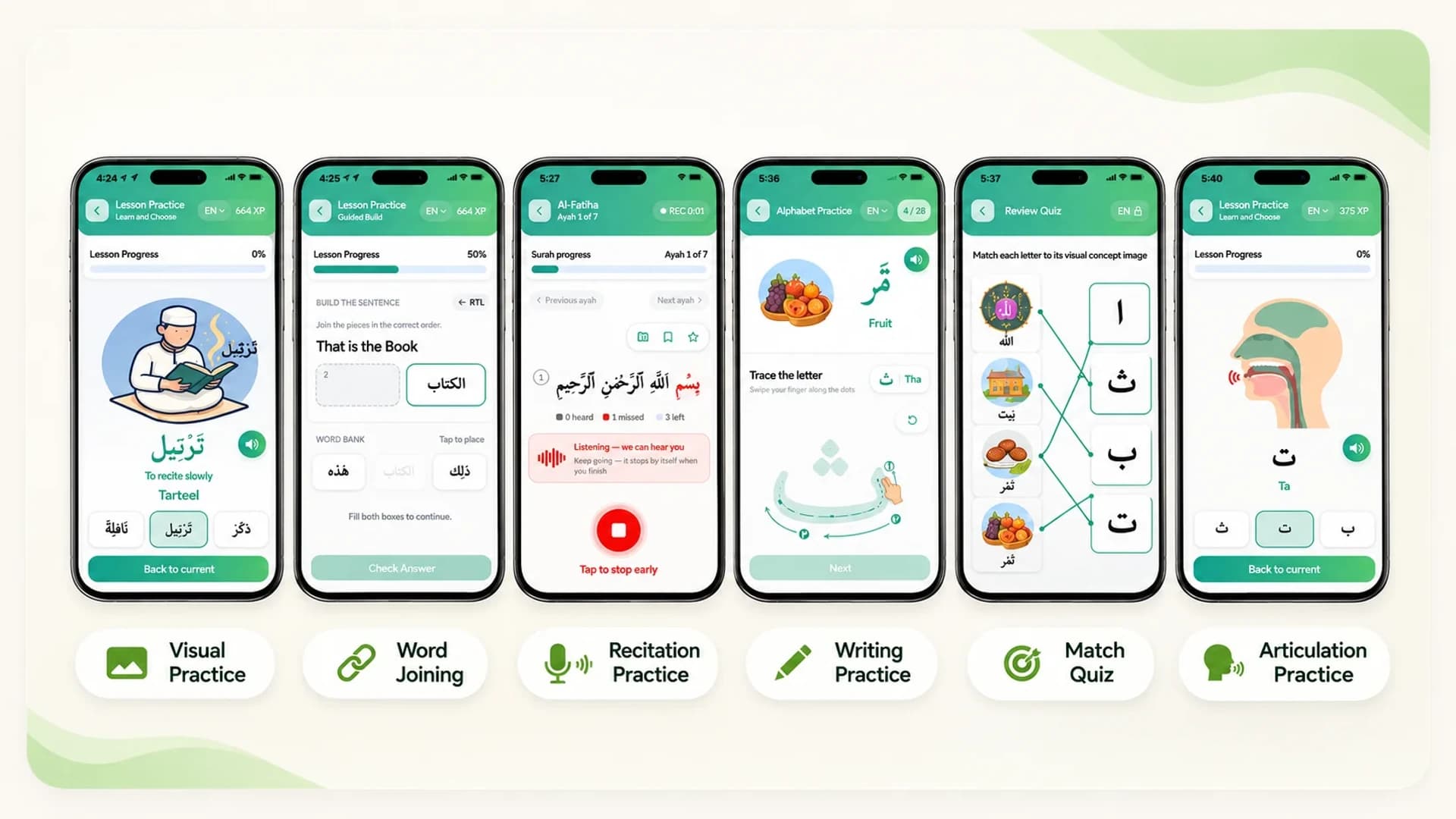
NorAI includes Visual Learning as one of its practice types.
Use audio to become familiar with sounds
Listening gives you examples of how the Arabic material you're studying sounds.
You can listen to suitable examples and revisit them during later sessions.
NorAI's Audio activities provide another way to practise lesson material.
Practise articulation and pronunciation
Some Arabic sounds may be unfamiliar if you haven't studied the language before.
Articulation practice helps you focus on how the sounds are formed.
NorAI includes Articulation activities as part of its curriculum. Accurate Quran recitation and Tajweed still require qualified guidance.
Use writing to revisit what you've learned
Writing activities give you another opportunity to work with familiar lesson material.
They can help you pay attention to the letters and words you're studying instead of only recognising them on sight.
NorAI also includes Writing practice.
Check your learning with matching activities
After studying familiar words and lesson material, matching activities can help you check what you recognise.
NorAI includes Match Quiz activities for this purpose.
For learners who have progressed further in the curriculum, Word Joining is introduced from Level 16.
You don't need to use every practice type in every session. Follow the activities available at your current level.
How Does NorAI Help Adults Start Quran Learning from Zero?
NorAI offers a structured 20-level Quran learning curriculum designed to help learners move from the foundations towards recognition, understanding, practice and review.
The curriculum is divided into four stages:
| Levels | Learning stage |
|---|---|
| 1–5 | Foundations |
| 6–10 | Recognition & Understanding |
| 11–15 | Practice & Patterns |
| 16–20 | Connections & Review |
If you're a complete beginner, the foundational lessons provide a starting point.
As you progress, NorAI introduces activities that support different learning skills, including visuals, audio, articulation, writing, matching and, from Level 16, Word Joining.
The goal is to follow a clear learning path rather than jump between unrelated lessons.
NorAI also supports lesson review and progress tracking, so you can return to familiar material and continue from your learning level.
Start Learning the Quran with NorAI
Never learned Arabic letters before? Begin with NorAI's foundational lessons and work through a structured learning path at your own pace.
Practise with visuals, audio, writing and guided activities as you develop your Quranic Arabic skills.
Free to start. Begin with lessons suited to your current level.
How Much Time Should Adults Spend Learning the Quran Each Day?
You don't need a long study session to begin.
If you're balancing work, family and other responsibilities, a shorter routine may be easier to maintain.
You could start with 10–15 minutes and adjust your study time as needed.
Here's an example of a 15-minute learning session:
| Time | Activity |
|---|---|
| 3 minutes | Review familiar letters or words |
| 5 minutes | Complete a suitable learning activity |
| 4 minutes | Listen to or practise the material |
| 3 minutes | Check what you remember |
This is a suggested study routine, not a religious requirement or a guaranteed learning method.
If a lesson is difficult, use your next session to review it.
Learning something new every day isn't necessary. Revisiting familiar material is also part of learning.
How Long Does It Take an Adult to Learn Quran Reading?
There is no fixed timeline for every learner.
Someone who remembers Arabic letters from childhood may begin at a different level from someone learning them for the first time.
Your progress depends on your previous knowledge, practice, learning goals and guidance.
Rather than expecting to read fluently within a particular number of days, focus on smaller goals.
You might begin by recognising a few letters without assistance.
Later, you may become more comfortable reading connected letters or recognise familiar Quranic words more easily.
These changes can show you which skills are developing and what still needs practice.
What If I Learned the Quran as a Child but Forgot?
You may not need to start from the beginning.
Think about what you still remember.
Can you recognise Arabic letters? Do you remember how they join together? Can you read familiar words without relying only on memory?
If you remember most letters but struggle with word reading, revisit the connected forms.
If you've forgotten the alphabet, begin with the foundations.
Returning to earlier material can help you identify what you know and what needs more attention.
Should I Learn Quran Reading or Word Meanings First?
If you're starting from zero, Arabic letters and basic reading skills are a useful place to begin.
As you become familiar with the written words, you can introduce the meanings of common Quranic vocabulary.
For example, Surah Al-Faatiha (1:2) contains the phrase Alhamdu lillah, expressing that all praise belongs to Allah.
You may already recognise the phrase because you've heard it in recitation.
Learning its meaning can help you connect familiar Arabic words with what they express.
However, understanding a complete verse requires reliable explanations and attention to context.
NorAI's article on 100 common Quranic words and their meanings provides additional vocabulary examples.
Reading practice and learning meanings can both be part of your routine as your ability develops.
How Can You Practise Quran Recitation at Home?
Once you've developed suitable reading skills, you can begin practising short Quran passages.
A simple approach is to listen to a reliable recitation, follow the written Arabic and read aloud at a comfortable pace.
Return to words that you find difficult before attempting the passage again.
The Quran refers to measured recitation in Surah Al-Muzzammil (73:4).
For additional practice, NorAI offers Ayah-by-Ayah Nazra Coach, a beta feature for listening, reciting and receiving automated feedback on individual words.
It can flag words for another attempt. For example, learners ready for recitation practice can use the Surah Al-Faatiha practice page.
Nazra Coach supports practice but doesn't replace qualified recitation instruction. Tajweed with a qualified teacher is recommended.
Common Mistakes Adults Make When Starting Quran Learning
Trying to learn too much at once
It's easy to feel motivated to cover several lessons when you're beginning.
But a large amount of unfamiliar material can leave little time for revision.
Choose a manageable learning goal and build on it.
Skipping Arabic reading basics
If letters and their joined forms are still unfamiliar, longer passages may become difficult.
Return to the reading skill that needs attention.
Depending only on memorised recitation
Knowing how a surah sounds doesn't necessarily mean you can read its written words.
If learning to read is your goal, include written Arabic practice in your routine.
Moving forward without revision
A lesson may feel familiar immediately after studying it, but remembering it later takes practice.
Revisit earlier material regularly instead of focusing only on completing new lessons.
Comparing your progress with others
Some adults have learned Arabic before. Others are beginning from zero.
Your current ability is a better guide for choosing lessons than someone else's experience.
How Do You Know You're Making Progress?
Progress doesn't always mean completing another level.
You may begin recognising letters that once confused you, reading familiar words with less help or remembering material from an earlier session.
Ask yourself:
- Can I recognise the letters I've studied?
- Do I remember how familiar letters join together?
- Can I read a word that I previously struggled with?
- Can I remember material from earlier lessons?
- Do I know what I need to review next?
These questions can help you decide where to focus your next learning session.
Frequently Asked Questions
Is it too late to learn the Quran as an adult?
No. Adults can begin learning the Quran at any age, even without previous Arabic knowledge. Starting with Arabic letters, basic reading skills and regular revision can help you build a foundation.
How do I start learning the Quran from scratch?
Begin by recognising Arabic letters and learning their sounds. Then practise how letters join together, learn basic reading marks and read suitable Arabic words before moving towards Quran passages.
Can I learn to read the Quran without knowing Arabic?
Yes. You can begin learning to read Quranic Arabic without speaking or understanding Arabic. Reading Arabic and understanding Quranic meanings are different skills that can develop over time.
How long does it take an adult to learn Quran reading?
There is no fixed timeline. Your progress depends on previous knowledge, regular practice, learning goals and guidance. Focus on manageable lessons and return to earlier material when needed.
Can I learn the Quran at home as a beginner?
Yes. You can begin with Arabic letters, audio activities and structured reading practice at home. NorAI offers a 20-level Quranic Arabic curriculum for adult beginners. For accurate recitation and Tajweed, learning with a qualified teacher is recommended.
It's Not Too Late to Begin
You don't need to wait until you know more Arabic or have a perfect study routine.
If you're starting from zero, begin with the letters. If you remember some reading skills, review what you've forgotten. If you're ready to learn Quranic words, choose a suitable next lesson.
Focus on what you can learn today and continue through regular practice.
NorAI offers a structured starting point for adults who want to develop their Quranic Arabic reading and vocabulary skills.
Ready to begin? Start learning with NorAI.
Download NorAI on Google Play | Download NorAI on the App Store