

Weekly Quran Learning Plan for Families: 7-Day Schedule
Finding time for Quran learning can be difficult when everyone in the family has a different routine. Parents have work and household responsibilities, while children have school, homework and other commitments. Even when a family wants to learn together, deciding what to study each day can be challenging.
A weekly Quran learning plan helps families organise their time and gives each person something suitable to work on. Parents can learn alongside their children, even when their Arabic reading abilities are different.
You do not need to cover a new lesson every day. Some days can focus on listening or understanding, while others are better suited to reading, practice and revision.
Quick answer: A weekly Quran learning plan can divide learning into seven activities: listening, Arabic reading, understanding Quranic words, recitation practice, recognition exercises, revision and family review. Begin with around 10–15 minutes a day if that suits your family, and adjust the schedule to each person's ability.
Key takeaways
- Set a weekly Quran learning routine that fits your family's schedule.
- Give adults and children activities suited to their own levels.
- Combine listening, Arabic recognition, reading, understanding and revision.
- Revisit earlier lessons instead of introducing new material every day.
- Use a weekly review to decide what to study next.
What Is a Weekly Quran Learning Plan?
A weekly Quran learning plan is a seven-day schedule that organises Quran study into manageable activities. It helps families decide when to listen, read, practise, understand and review Quranic material.
The schedule can be adapted for an adult beginner, a child studying Arabic letters or a family member who already reads the Quran.
There is no requirement for every family member to complete identical lessons. A parent might study familiar Quranic words while their child practises recognising Arabic letters.
The Prophet Muhammad ﷺ encouraged learning and teaching the Quran, as recorded in Sahih al-Bukhari 5027.
A weekly schedule is simply a way to organise learning. It is not a religiously prescribed timetable.
7-Day Quran Learning Schedule for Families
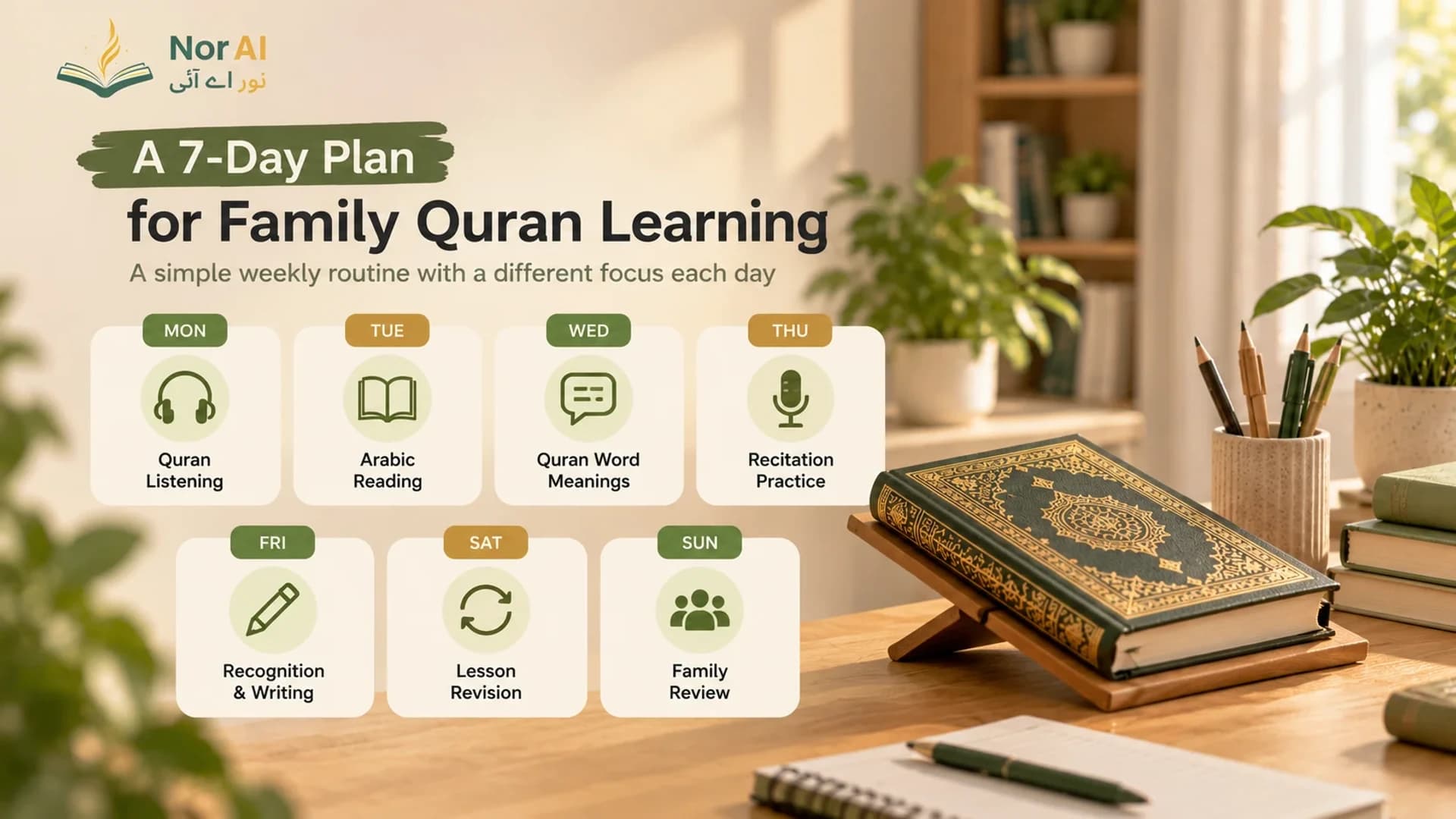
This schedule gives each day a different learning focus. Adults and children can work on related skills without needing to complete the same exercises.
| Day | Learning focus | Children's activities | Adults' activities |
|---|---|---|---|
| Monday | Quran listening | Listen to a short passage and recognise familiar sounds | Listen while following the Arabic text, if able |
| Tuesday | Arabic reading | Review letters, connected forms or familiar words | Practise reading words or a short passage |
| Wednesday | Quran word meanings | Learn one or two familiar Quranic words | Study vocabulary from the selected passage |
| Thursday | Recitation practice | Listen, repeat and revisit suitable material | Read aloud and identify words needing correction |
| Friday | Recognition and writing | Complete suitable matching or writing exercises | Review familiar Arabic forms and vocabulary |
| Saturday | Revision | Repeat activities that were difficult earlier in the week | Review reading, pronunciation and meanings |
| Sunday | Family review | Share what was learned and ask questions | Review progress and choose next week's focus |
Suggested session length: Around 10–15 minutes may be a starting point for some families. Sessions can be shorter or longer depending on the learner's needs.
This plan is flexible. You can begin on any day and repeat a session whenever necessary.
Monday: Start with Quran Listening
Listening allows learners to become familiar with Quranic sounds and recitation.
For beginners, listening can come before independent reading. Learners who already read Arabic can follow the text while listening.
Choose a short passage suited to each person's ability.
Listening Activities for Families
For children: Listen to a suitable Quran passage and encourage recognition of sounds or words your child already knows.
For adults: Follow the Arabic text while listening, noting any words or sounds that require further attention.
For families learning together: Listen to the same short passage, then let each person share something they recognised.
For example, families can use Surah Al-Faatiha recitation practice when the passage suits their learning level.
A child may focus on listening, while an adult follows the Arabic text or revisits familiar words.
Monday's Learning Goal
Become more familiar with the selected passage and identify something to review during the week.
Listening supports learning, but accurate Quran pronunciation and Tajweed should also be studied with a qualified teacher.
Tuesday: Build Arabic Reading Skills
Arabic reading skills develop at different rates.
Some children need to recognise individual letters, while others are ready to work with connected forms or familiar Quranic words. The same applies to adults who are beginning to learn Arabic.
Tuesday's activity should match the learner's current ability.
Arabic Reading Activities by Learning Level
| Learning level | Suggested activity |
|---|---|
| New beginner | Recognise a small group of Arabic letters |
| Early reader | Identify familiar letters in connected forms |
| Developing reader | Read suitable connected letters and words |
| More experienced reader | Read a short passage and revisit unfamiliar words |
Parents can guide their children through suitable reading exercises while completing their own learning activities.
NorAI's 20-level Quran learning curriculum begins with Arabic foundations and progresses through recognition, understanding, practice and review.
Families can choose activities suited to each person's current level instead of expecting everyone to follow the same lesson.
Tuesday's Learning Goal
Improve recognition or reading of the material selected for the session.
If connected letters remain difficult, repeat those exercises before moving to more advanced reading.
Wednesday: Understand Familiar Quranic Words
Understanding Quranic vocabulary can help learners recognise words encountered during reading and listening.
For a child who is beginning Quran learning, understanding one or two familiar words may be enough.
An adult learner may study several words from a short passage using a reliable translation.
Choose vocabulary connected to material the learner already recognises.
For more examples, families can refer to NorAI's guide to 100 common Quranic words and their meanings. Parents can choose a small selection of words suited to each learner's level.
Quran Vocabulary Learning Example
Families studying Surah Al-Faatiha can use a familiar passage to introduce Quranic vocabulary.
For example, Surah Al-Faatiha (1:2) contains the phrase Alhamdu lillah, expressing that all praise belongs to Allah.
Parents can use this example during Wednesday's Quran learning session:
- Listen: Play a reliable recitation of the selected ayah.
- Recognise: Help the child identify the familiar phrase while following the Arabic text, if they can read it.
- Understand: Explain its meaning using a reliable Quran translation.
- Review: Return to the same phrase and ask what it means.
Children can focus on recognising the phrase and remembering its meaning. Adults who are ready can study additional vocabulary from the passage.
Wednesday's learning goal: Recognise familiar Quranic words and begin understanding their meanings within the selected passage.
Individual word meanings are an introduction to Quran understanding. The meaning of a complete ayah should always be considered in its context.
Thursday: Quran Recitation Practice for the Family
Thursday can focus on reading aloud and revisiting difficult words.
The activity should suit each person's level.
A beginner may still be practising sounds or short combinations. Someone who already reads Arabic can work with a short Quran passage.
Recitation Activities for Adults and Children
For children: Begin with previously introduced material. Listen, repeat and revisit words that need more attention.
For adults: Read a short passage aloud and identify words that are difficult to pronounce or recognise.
For families: Allow each person to complete an appropriate activity before reviewing what they found difficult.
The Quran instructs measured recitation in Surah Al-Muzzammil (73:4). This is a Quranic reference about recitation, not a requirement to complete a particular amount of reading on Thursday.
NorAI's Ayah-by-Ayah Nazra Coach is a beta feature that supports listening, recitation and automated word-level feedback.
Learners can use it to identify words that may need another attempt.
For another short-Surah example, families who already recognise the text can practise Surah Al-Ikhlas recitation.
Nazra Coach is a learning aid. It does not replace a qualified Quran teacher or provide a complete Tajweed course. Tajweed with a qualified teacher is recommended.
Thursday's Learning Goal
Complete a suitable recitation activity and identify words or sounds that require further attention.
Reading accuracy matters more than finishing a large passage in one session.
Friday: Review Arabic Recognition and Writing
Friday's session gives children and adults another opportunity to recognise previously studied Arabic letters, forms or words.
Activities can include visual recognition, matching and writing where appropriate.
The aim is to revisit familiar material using a different exercise.
Suggested Friday Activities
- Recognise Arabic letters introduced earlier in the week.
- Identify familiar connected forms.
- Complete suitable matching exercises.
- Practise writing where it forms part of the learner's lesson.
- Review familiar words before moving to new material.
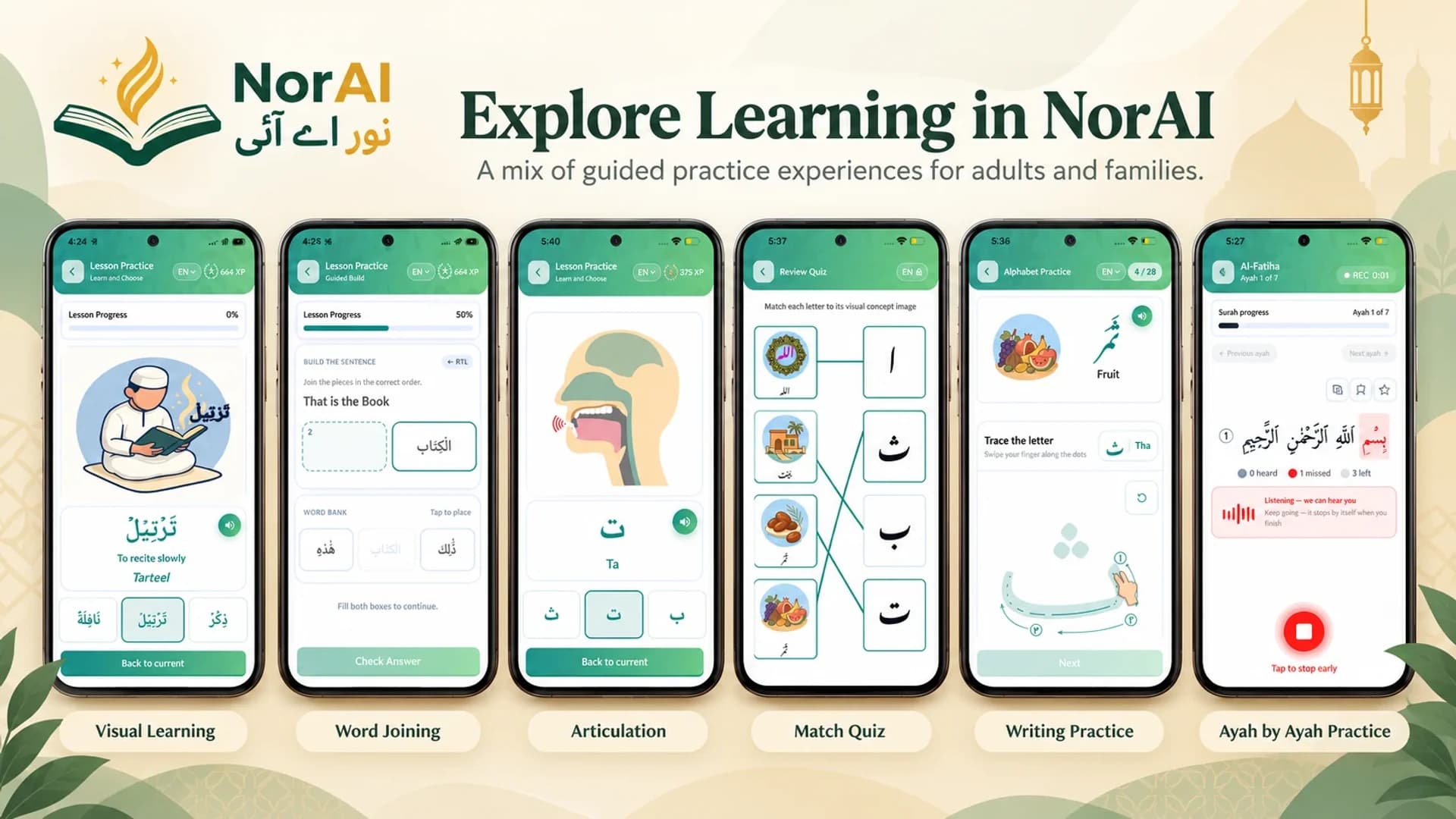
NorAI includes visual learning, articulation, audio, writing and matching activities in its Quran curriculum.
Word Joining is introduced from Level 16, so it should not be treated as a beginner-level exercise.
Parents should choose activities available at their child's current learning stage.
Friday's Learning Goal
Improve recognition of previously studied material through suitable exercises.
If an activity remains difficult, include it in Saturday's revision.
Saturday: Revise the Week's Quran Lessons
Revision gives families time to revisit material introduced earlier in the week.
Not every session needs to introduce new content.
Children and adults may benefit from repeating letters, reading patterns, words or passages that remain unfamiliar.
Weekly Quran Revision Checklist
- I listened to the selected Quran passage.
- I recognised the letters or words studied this week.
- I completed reading activities suited to my level.
- I reviewed familiar Quranic word meanings.
- I identified something that needs more practice.
Parents can review their children's progress without comparing them with siblings or other learners.
For example, a child who struggled with connected letters on Tuesday can revisit those forms instead of starting something new.
An adult who found a reading passage difficult can repeat the same passage.
Saturday's Learning Goal
Identify what has become more familiar and what needs further practice.
If a lesson remains difficult, repeat it in the following week.
Sunday: Review Progress and Plan the Next Week
A family review gives everyone an opportunity to discuss what they learned.
This does not need to be a formal assessment.
Parents can ask questions, listen to their children's experiences and review their own learning.
Questions for the Weekly Review
- What did you learn this week?
- Which activity did you find difficult?
- Which Arabic letters or words can you recognise?
- What would you like to practise again?
- Are you ready for a new lesson?
Use the answers to decide what comes next.
If a child is still becoming familiar with Arabic letters, continuing with recognition activities may be more suitable than introducing longer reading exercises.
Sunday's Learning Goal
Choose the next week's focus according to actual progress.
There is no need to advance simply because another week has begun.
How Much Time Should Families Spend Learning the Quran?
There is no fixed daily duration that suits every learner.
The time needed depends on reading ability, age, attention and the type of activity.
For families establishing a new routine, the following timings can be used as starting examples.
| Learner | Example duration | Suggested focus |
|---|---|---|
| Child beginning Quran learning | 5–10 minutes | Listening or letter recognition |
| Child developing reading skills | 10–15 minutes | Reading exercises and revision |
| Adult beginner | 10–20 minutes | Arabic foundations or suitable reading material |
| Family review | 10–15 minutes | Revisiting progress and planning |
These timings are educational suggestions, not religious requirements or guaranteed learning outcomes.
A family may prefer a short session after school, while another may have more time during the evening.
The schedule should fit the household rather than becoming another source of pressure.
One Weekly Quran Learning Plan for Different Levels
Family members do not have to study identical material to learn together.
A parent may already read Arabic while their child is beginning with letter recognition.
In another family, an older child may read familiar passages while an adult is returning to Quran learning after several years.
A shared timetable can still work.
Example: Different Learning Levels in One Family
| Family member | Current ability | Weekly focus |
|---|---|---|
| Parent | Can read Arabic but wants more revision | Reading practice and familiar word meanings |
| Older child | Recognises letters and some connected forms | Connected letters and familiar word patterns |
| Younger child | Beginning Arabic recognition | Listening and letter recognition |
On Monday, everyone can participate in listening activities.
On Tuesday, each person can complete a reading exercise suited to their level.
On Sunday, the family can review progress together.
This keeps Quran learning part of family life without expecting everyone to advance at the same speed.
Tips for Maintaining a Family Quran Learning Routine
A learning schedule is easier to follow when activities are clear and manageable.
Families can make adjustments when school, work or other responsibilities interrupt the usual routine.
Keep Each Learning Goal Manageable
Choose a limited amount of new material for each session.
A child who is still recognising connected Arabic letters may need repeated exercises before moving on.
Include Regular Revision
Do not treat every session as an opportunity to introduce something new.
Revisiting familiar material helps learners identify what they remember and where they need more support.
Let Parents Learn Alongside Their Children
Parents can complete their own Quran learning activities while managing their children's learning.
This gives adults opportunities to continue learning without requiring every family member to study the same lesson.
Choose Learning Tools for Their Intended Purpose
Different resources serve different purposes.
Listening tools can help learners hear Quran recitation. Reading exercises can support Arabic recognition and practice. Reliable translations can introduce Quranic meanings.
Qualified instruction remains important for accurate recitation and Tajweed.
Using NorAI for Family Quran Learning

NorAI is a Quran and Islamic learning app designed for adults and families, including parent-managed learner profiles. Its family Quran learning and progress tracking features help parents follow their children's learning while continuing their own Quran learning journey.
It provides a structured 20-level Quran learning curriculum organised into four stages.
| Levels | Curriculum stage |
|---|---|
| 1–5 | Foundations |
| 6–10 | Recognition & Understanding |
| 11–15 | Practice & Patterns |
| 16–20 | Connections & Review |
The curriculum includes visual learning, articulation, audio, writing and matching exercises.
Word Joining becomes available from Level 16.
How NorAI Fits into the Weekly Schedule
| Day | Suggested use |
|---|---|
| Monday | Listen to suitable audio learning material |
| Tuesday | Complete Arabic recognition or reading activities |
| Wednesday | Review familiar Quranic vocabulary |
| Thursday | Use Nazra Coach for suitable recitation practice |
| Friday | Complete relevant writing or matching exercises |
| Saturday | Revisit previously studied lessons |
| Sunday | Review progress and decide what to study next |
This table shows one way families can use NorAI within their own schedule. It is not a built-in seven-day programme that NorAI automatically assigns.
NorAI's Family plan allows parents to manage minor learner profiles while continuing their own learning.
Supported lesson packs and audio downloads can also be used offline, although some features require an internet connection.
For parents who want guidance on getting started, NorAI's Quran learning for children at home guide offers a checklist for organising learning activities and supporting children at different stages.
Digital resources can support learning, but they should be used alongside reliable educational material and qualified instruction when needed.
Common Mistakes in a Weekly Quran Learning Schedule
Giving everyone the same lesson: Parents and children may have different Arabic reading abilities. Their activities should reflect those differences.
Introducing too much new material: Trying to cover long passages or large vocabulary lists in one session can leave little time for revision.
Skipping listening activities: Listening provides opportunities to become familiar with Quranic sounds and recitation.
Learning word meanings without context: Individual vocabulary meanings can support recognition, but full passages require reliable explanation.
Moving forward without reviewing: If familiar material remains difficult, return to it before adding more.
Comparing family members: A child learning letters and an adult reading familiar surahs should not be expected to progress identically.
Treating automated feedback as complete instruction: App-based practice tools have limits and do not replace qualified Quran teachers.
The purpose of a weekly routine is to provide direction while allowing everyone to learn according to their ability.
Frequently Asked Questions
What is the best weekly Quran learning plan for families?
A weekly Quran learning plan can include listening, Arabic reading, Quran word meanings, recitation practice, recognition activities and revision. Families can distribute these activities across seven days and adapt them to each person's ability.
How do I create a Quran learning schedule at home?
Begin by identifying each family member's starting level. Choose a suitable learning time, assign activities to different days and include regular revision. Review progress at the end of the week before planning new lessons.
Can parents and children follow the same Quran learning schedule?
Yes. Parents and children can share the same weekly topics while completing different activities. A parent may practise reading familiar passages while their child works on Arabic letter recognition.
How much Quran should a child learn each day?
There is no single amount that suits every child. A beginner may start with a few Arabic letters, familiar words or a short reading activity. The amount should reflect the child's ability and understanding.
Is 10 minutes a day enough for Quran learning?
Ten minutes can be a starting point for some beginners. Other learners may need longer sessions or additional instruction, depending on their goals and reading level.
What should beginners learn first when starting Quran learning at home?
Both can be introduced at an appropriate level. Some children may need to focus initially on recognising Arabic letters, while others can study familiar Quranic words and meanings alongside reading practice.
How often should families revise Quran lessons?
Revision should be included regularly. A weekly review session is one option, but learners can also revisit familiar material throughout the week whenever needed.
What if my child misses a day of Quran learning?
Continue from the last completed activity. There is no need to make the next session unusually long. Families can move an activity to another day or repeat the current week's schedule.
Can families use NorAI for their weekly Quran learning routine?
Yes. Families can use NorAI's structured Quran curriculum, suitable learning exercises and Nazra Coach practice feature as part of their own weekly routine. Parents can manage minor learner profiles while continuing their own learning.
The seven-day schedule in this article is a suggested plan, not an automatic schedule generated by NorAI.
Building a Quran Learning Routine That Works for Your Family
A weekly Quran learning plan gives families a way to organise listening, reading, understanding and revision.
Some days may focus on new material, while others are better used for repeating what has already been learned.
Parents and children can follow the same weekly structure without needing identical lessons.
The most useful schedule is one that fits the family's circumstances and helps each person recognise what to study next.
Learn Quran & Islam with NorAI
Continue your family's Quran and Islamic learning journey with NorAI. Access structured lessons, interactive practice and scholar-reviewed learning content designed for adults and families.
NorAI is free to start. Download the app: